Category: Email Marketing

  • 🚀 The Ultimate Guide to Welcome Flows: Turning Browsers into Customers

    🚀 The Ultimate Guide to Welcome Flows: Turning Browsers into Customers

    📩 What is a Welcome Flow?

    A Welcome Flow is an automated series of emails triggered when a subscriber first joins your email list — typically after signing up, downloading a guide, or creating an account.

    It’s often your first direct line of communication with potential customers, making it one of the most important flows in your entire email marketing system. Typically, these emails generate up to three times more revenue than standard promotional campaigns because they reach subscribers at a moment of peak intent—right after they’ve opted in for a promo code or requested to learn more about your brand.

    Studies show that 74% of subscribers expect to receive a welcome email immediately after signing up. The average open rate of a welcome email in 2024 was 34.79%, with the highest conversion rate of 2.91%. Done right, it becomes one of the highest-ROI automations in your entire ecommerce strategy.

    What a Decision-Support Welcome Flow Should Include

    1. A Clear Brand Introduction

    The first email should welcome subscribers, explain who you are, and set the stage for what is to come. But more than that, it should frame your brand around solving their problems. By making your value proposition and mission clear from the beginning, you position yourself as the solution they’ve been searching for.

    2. Guided Product Recommendations

    Instead of showing every product in your catalog, focus on a curated selection. Use segmentation data (such as browsing behavior or quiz results) to recommend products tailored to their interests. A “Start Here” email that explains your bestsellers or most-loved options makes the buying path clearer.

    3. Education and Comparison

    If your products require explanation (e.g., skincare, supplements, or high-ticket items), dedicate an email to education. This can include:

    • Side-by-side comparisons
    • Explainer videos or infographics
    • “Which product is right for you?” guides

    By simplifying complexity, you help customers see which option fits them best.

    4. Social Proof and Stories

    Nothing reassures a hesitant shopper like seeing someone else’s success. Use your welcome series to showcase testimonials, reviews, or case studies. Highlighting how different types of customers use your products makes it easier for subscribers to see themselves making the same decision.

    5. Objection Handling

    Customers hesitate for specific reasons: price, quality concerns, or doubts about effectiveness. Your welcome flow is the perfect place to address these head-on. Include guarantees, easy return policies, or FAQs to proactively remove these barriers.

    6. Personal Connection

    Adding a text-based, conversational email (as if it’s from the founder or a team member) can go a long way. This human touch makes the experience feel less transactional and more like guidance from a trusted friend.

    7. Decision Nudges (Discounts + Urgency)

    Finally, reinforce the decision by giving them a reason to act now. A time-sensitive discount, free shipping, or “last chance” reminder ensures they don’t delay indefinitely. The goal is to remove hesitation and replace it with action.

    Examples of Welcome Emails

    1. Deliver their discount immediately.

    Fulfilling the promised discount in your welcome email motivates subscribers to explore your products and make their first purchase sooner.

    2. Message from the Founders

    A personal note from founder humanizes the brand, while vibrant visuals showcase its packaging. Mentions in popular media outlets such as Forbes, Popsugar, and Buzzfeed add social proof that reinforces credibility.

    3. Build Trust with Gratitude

    Expressing gratitude in your welcome email makes customers feel valued and sets the stage for a positive relationship from day one.

    4. Show off your best-sellers

    The welcome email should showcase your best-sellers with eye-catching images, clear ‘SHOP NOW’ buttons, and a friendly ‘TAKE XXX OFF’ offer—highlighting the brand’s value and nudging subscribers toward their first purchase.

    5. Share your brand’s story

    People are drawn to brands with a compelling story because it fosters a personal connection. Use your welcome email to share your journey, values, or inspiration—helping customers feel more engaged and invested in your brand.

    6. Win trust with social proof

    Featuring real customer reviews in your welcome email builds credibility, and pairing them with a discount can boost conversions.

    🏗️ Common mistakes brands make with Welcome Flows

    Compress all brand information into 2-3 dense emails over 3 days, overwhelming subscribers…
    Stop emailing too soon, leaving a lot of potential sales on the table.
    ❌ Not handling objections in the welcome series
    ❌ Sending almost the exact same email multiple times.
    ❌ Not testing different offers.
    ❌ Boring the customer.

    Modern consumers don’t read heavy emails. They want bite-sized stories, trust-building proof, and gentle nudges over a longer period. That’s why a 3-8 email Welcome Flow that meets these requirements works so well.

    Welcome Flow Non-Negotiables

    If you want your welcome flow to perform at its highest level, there are a few elements that aren’t optional. These are the high-leverage practices that make the difference between a welcome series that simply “exists” and one that actually converts subscribers into customers.

    1. Turn Off Double Opt-In

    Every extra step creates friction. Double opt-in may sound good in theory, but in practice it costs you sign-ups. By turning it off, you capture more leads instantly—especially since subscribers already expect the welcome email right after signing up.

    2. First Email Fires Immediately Upon Sign-Up

    Timing is everything. Your brand is top-of-mind the moment someone subscribes. Waiting hours (or worse, days) kills momentum. The first email should hit their inbox instantly to capitalize on that interest.

    3. At Least 3 Emails Long

    One email isn’t enough to build a relationship. A minimum of three emails gives you space to welcome subscribers, tell your brand story, and make an offer. Shorter flows leave money on the table.

    4. Emails Sent 1–2 Days Apart

    Spacing matters. Too far apart, and you lose attention. Too close together, and you risk overwhelming people. A cadence of 1–2 days keeps your brand fresh without creating fatigue.

    5. Remind of Welcome Discount in Every Email

    Subscribers sign up expecting a perk—usually a discount. Repeating that offer in every email reinforces urgency and ensures they never forget it. Skipping reminders often means leaving sales on the table.

    6. Include a Text-Based Email

    Not every email should look like a polished newsletter. A plain text, conversational email feels more personal—like a message from a friend rather than a brand. These often cut through the noise and drive high engagement.

    7. Include a Last-Chance Discount Email

    Urgency converts. A final reminder that their welcome discount is expiring creates FOMO (fear of missing out) and pushes fence-sitters to act. Without this, many subscribers may delay—and never come back.

    What You Need to Start a Welcome Flow

    Before you can launch an effective welcome flow, make sure you have the following in place:

    1. A Sign-Up Form or List Source
      – Create a pop-up, embedded form, or landing page to collect email addresses. This is what triggers the welcome flow.
    2. A Connected Ecommerce Platform
      – Sync your Shopify, WooCommerce, BigCommerce, or other ecommerce store with Klaviyo to pull in customer data.
    3. A Defined Audience
      – Decide who should receive the welcome flow (e.g., all new subscribers, or specific segments like non-customers).
    4. Your Brand Story & Messaging
      – Outline what you want new subscribers to learn about your brand—your mission, values, and what makes you unique.
    5. Compelling Offers and Risk Reversals
      – Decide on what type of incentives to encourage a first purchase. Decide in advance how you’ll address the most common objections prospective customers have when considering your products.
    6. Email Content & Creative Assets
      – Write your email copy, prepare visuals, and create a consistent design that matches your brand identity.
    7. A Flow Structure
      – Map out the number of emails (usually 3–8) and the timing between them. Each email should serve a specific purpose: welcome, brand story, social proof, product highlights, or an incentive reminder.
    8. Automation & Triggers
      – Set the automation trigger (e.g., “when someone subscribes to a list”) and configure timing rules.
    9. Smart Sending & Deliverability Settings
      – Enable Klaviyo’s Smart Sending to avoid over-emailing and ensure your messages hit inboxes, not spam folders.
    10. Analytics Setup
      – Decide on the metrics you’ll track (open rates, click-throughs, conversions, revenue per recipient) so you can measure and optimize performance.

    The Bottom Line

    Helping customers make decisions is at the heart of effective email marketing. Your welcome flow isn’t just about saying hello—it’s about reducing overwhelm, clarifying options, and guiding subscribers to the product that’s right for them.

    When you act as a decision-making partner rather than just another brand shouting offers, you build trust, increase conversions, and lay the foundation for long-term loyalty.

    In today’s crowded ecommerce landscape, the brands that win aren’t the ones with the most products—they’re the ones that help customers make the best decisions.
  • Lists vs. Segments: The Foundation of Smart Email Marketing

    Lists vs. Segments: The Foundation of Smart Email Marketing

    When it comes to building a successful email marketing strategy in Klaviyo (or any platform), there are two core building blocks you need to understand: lists and segments. While they may sound similar, they serve very different purposes—and knowing how to use them correctly is the difference between a healthy, high-performing program and one that struggles with poor deliverability and low engagement.

    Think of it like this:

    • Lists are containers. Once someone goes into a container, they stay there until you take them out.
    • Segments are filters. They automatically sort people in and out based on rules you’ve defined.

    Let’s break that down.


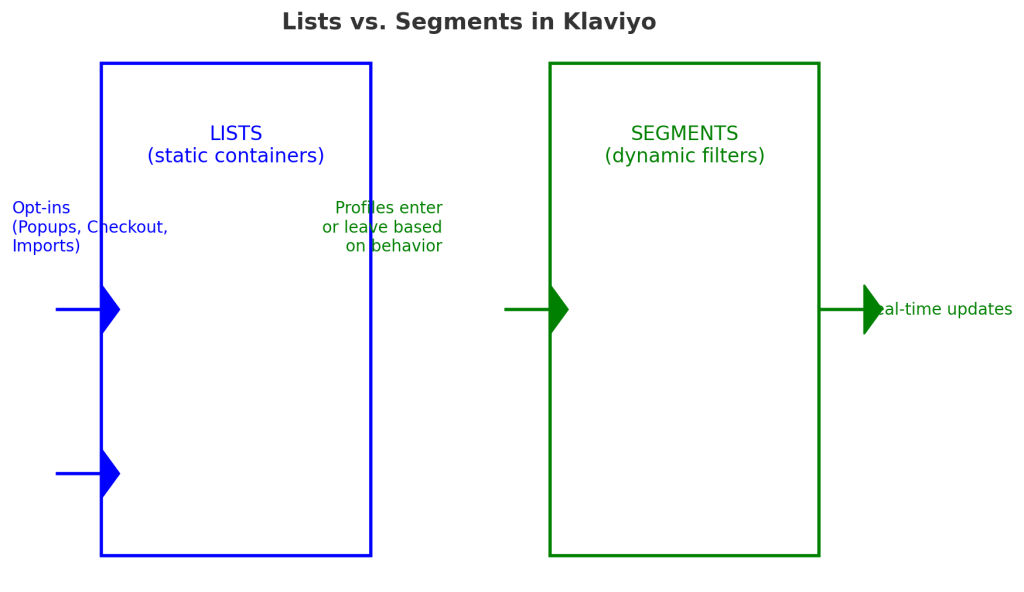
    Diagram comparing "Lists" and "Segments" in Klaviyo. "Lists" are static, showing opt-ins via popups, checkout, imports. "Segments" are dynamic with real-time updates.

    What Are Lists?

    Lists are static groups of subscribers. Once someone is added to a list, they stay there unless you manually remove them. That’s why lists are best for organizing opt-ins and triggering welcome flows.

    Why Lists Matter

    There are two main reasons you need to manage lists carefully:

    1. Tracking Growth Sources
      You should always have one primary email list and one primary SMS list for all your organic opt-ins—these are people signing up through your website’s pop-up forms or during checkout. Beyond that, create separate lists whenever you import subscribers from a different source. This allows you to track exactly where your subscribers are coming from, giving you clear insights into how your database is growing.
    2. Triggering the Right Welcome Flow
      When someone joins a list, that action usually triggers a welcome flow or nurture series. This is your chance to make a strong first impression—so the message needs to match the way they signed up. For example, if someone entered a giveaway on Instagram, the first email they receive shouldn’t be a “10% off your first order” message. Instead, it should acknowledge the giveaway, build excitement, and introduce them to your brand in the right context.

    So remember: lists are like containers for new opt-ins—clean, simple, and static.

    What Are Segments?

    Segments, on the other hand, are dynamic groups of subscribers. They constantly update in real time based on the criteria you set. A profile may enter or leave a segment at any moment, depending on their behavior, engagement, or attributes.

    Think of segments as filters: you define the rules, and Klaviyo automatically filters people in and out as their behavior changes.

    Why Segments Matter

    Segments are essential for campaign sending. Instead of sending your subscribers the same messages, you deliver personalized messages to specific groups of subscribers that share common characteristics or interests. Unlike lists, they’re designed to reflect current behavior and keep your deliverability strong. Here’s why:

    • Protect Your Sender Reputation
      Sending campaigns to your entire list is one of the fastest ways to damage deliverability. Many subscribers on your list may no longer be engaged, and every unopened email signals to inbox providers (like Gmail or Outlook) that your messages aren’t wanted. Segmentation solves this problem by letting you filter for engaged subscribers who actually want to hear from you.
    • Personalize at Scale
      Because segments can be based on almost any data point—purchase history, engagement with emails or SMS, browsing behavior—they’re the key to tailoring your campaigns. Whether you want to re-engage lapsed customers, upsell recent buyers, or nurture prospects, segments make it possible.
  • 📝 10 Types of Engaging Email Campaign Content to Keep Subscribers Hooked

    📝 10 Types of Engaging Email Campaign Content to Keep Subscribers Hooked

    The modern customer wants to do their due diligence and understand the product they are buying. We want to remove as much friction as possible for them in that process. The content that wins will do two things:

    1. Educate the customer on a problem, a process or a solution.
    2. Position your product as the solution.

    If you can do both, you’ll guide your customer to making the right solution, and earn trust points in the process needed to make a buying decision.

    When it comes to ecommerce email marketing, fresh, diverse content is key to keeping your subscribers opening, clicking, and buying. Too many brands rely solely on discounts and generic “shop now” emails, which quickly leads to fatigue (and unsubscribes).

    Instead, here’s a powerhouse list of 10 types of content that can form the backbone of your campaigns. These ideas build trust, educate, entertain, and ultimately drive more sales — without feeling like constant sales pitches. Prioritize answering objections in your emails. Format your emails in a way that addresses common objections.


    Macrotopics vs Microtopics

    You can find thousands of quick and eaily digestible topics within your one product/niche. Find your large overaching topics and create microtopics off of them. Then create single emails about each one. E.g. if you sell protein supplements, and one thing you want your customers to know is that your products are created from organic ingredients, that’s a microtopic. A macrotopic would be everything we have in our supplement, while a microtopic is the fact that we use organic ingredients.

    Supplement Brand Microtopic Example

    Supplement Brand >> Macrotopic 1: Building muscle Macrotopic 2: Burning Fat Macrotopic 3: Diet Macrotopic 4: Overall Health

    Macrotopic 3: Diet

    Microtopics:

    • Best foods for dieting
    • How to know if you should diet
    • Best workouts while dieting
    • Best supplements to support dieting
    • Hacks for dieting
    • How to lower your appetite naturally
    • Ingredient xyz highlight

    One benefit of a product feature

    Focus on a single benefit of your product and what it brings to the customer. You should be able to come upwith 10+ of these singular benefits for each product in your store. You can repeat these campaigns. By highlighting one benefit, we make it easier for the customer to remember what we want to say. Write out 10 benefits and create singular emails about each benefit.

    A feature of a product

    Spotlight one product feature in detail. Your features are what makes you claim in your email that your product is unique. For example, all protein powders have the same benefit, which is to build muscle. But the features of your protein powder is what makes your product unique.

    People also want to know what is in their product, especially if it is a health product. You can also focus on features of a clothing product, e.g. you can focus on how much space a pocket has. Write out every ingredient or material in your product. Each one of those can be a singular feature that you highlight.

    FAQ

    This email helps overcome objections that are silently killing your conversions. Most consumers won’t email to ask, they’ll just bounce. Answering FAQs directly addresses hesitations, builds trust, and clears the path to purchase. It also shows that you’re a transparent brand that knows what customers care about.

    Address 5 common question your customers have about your product, and address them in the email. What may be common sense to you may not be common sense to the customer. You can have FAQ emails that tackle objections head-on and answer multiple questions if the answers are short and quick. For longer ones, you can create single emails out of them. Gather data from your support team that they get questions about.


    What’s Inside

    If you sell a package deal or have a consumer good, explain everything that comes with an order. Example: your ingredients. People want to know what they’re putting inside their bodies. It will help clear out the uncertainty that someone may have about ordering. Some brands will give away free product guides, but don’t tell their customers about them. This can be a nice bonus to get people over the edge.

    Unpack everything in your bundle or product and display it in a list format. Make sure it is easily skimmable and digestible. Example: Unboxing AGI: There’s so much to look forward to in your free Welcome Kit. And then present images of what the customer gets along with descriptions. Or. 7 super ingredients that heroically protect and defend paws.

    • Show your audience exactly what they’re getting.
    • Whether its ingredients, materials, or items in a bundle, transparency builds trust and makes the offer feel more tangible and valuable.
    • Perfect for skincare, CPG, supplement or bundle-based brands.

    How It’s Made

    An email explaining the creation process of your product. For example, the behind-the-scenes process you use to create the product could be something that proves the quality of your product. This gives your product a story and adds background to the product. List out every step of your process from materal gathering to factory product, to warehouse to shipment. A powerful email that explains how your product is made will be very engaging to your customers and can get someone over the edge.


    How it Works

    Purpose and Content

    • Educate subscribers on how your product actually words, especially if it’s not instantly obvious.
    • This reduces confusion, builds trust, and makes the customer feel confident taking the next step.
    • Lay it out in plain English and visually show the ease or transformation.

    How We’re Different

    Purpose:

    • Set your brand apart by clearly stating why you’re not like everyone else.
    • Most consumers are comparing you to competitors. This email helps them choose you.

    You want to clearly lay things out to show how you differ from your competitors to help them make their pick. The elephant in the room is that your customers are comparing you with your competitors to

    ld go with your brand. Throw in some social proof and the discount if this is a welcome flow email.

    How to Use

    This is an email that describes in a step-by-step process, how to use your product or how to get the best out of it. The best format to present this is a YouTube video which you can include in the email. You can also use clear, high quality images that makes it very simple for the customer. We want to be as clear as possible about our products.

    By laying out steps of how to use our product, the customer can see how easy it really is. If not, we leave it to their imagination, which has been known on overcomplicate things. We remove all uncertainty by explaining how to use it. If it is clothing, the email can be titled, “How to Style XYZ” or “How to Get the Most Out of Your Perfume.”

    Back in stock

    If you have a product back in stock, create a full email or two about it. Even if you don’t and just got some more product in, use this angle of Back In Stock to get more sales. If something is back in stock, it means it went out of stock because it was popular. And that means it may go out of stock again: Urgency. This angle mixes popularity and urgency at once.

    Example: “It’s back! Our viral leggings have finally returned.”


    Trending

    A feature email on your products that are performing well. People like to always be updated about the newest trends and popular products. Future trending works better than past trending: Here’s what’s going to be trending for the summer >> Here’s what was trending last summer. You can created curated product sections for the customer.
    Example: “These are flying off our shelves — see why everyone’s obsessed.”


    Reviews / Testimonials

    You should always have at least one filler email inside your welcome flow.

    Purpose:

    • Reinforce trust by showing proof from real customers.
    • This reduces friction, validates your claims and pushes the subscriber closer to conversion.
    • Don’t do more than 1-3 testimonials in an email to avoid overwhelming the customer.

    Pull reviews from your site and products and create an email featuring them. They prove you’re a legit brand, and show that other people are fans. Humans like to follow the herd. Pull testimonials that address an objection the customer may have. General testimonials won’t do much. E.g. “I struggled with acne for so long, but this product is so light on my skin” You can even take social media comments and integrate them in. Example: “Why 10,000+ shoppers swear by our weighted blanket.”

    Make sure you take time finding your testimonials. They need to overcome objections within them. Take time to find your good testimonials, because they’re going to do the selling for you.


    Us Vs Them

    An email comparing you vs your competitors clearly laid out. Display things superclearly for your customer. Display the facts and show how you differ. This will help them choose you over them. use a table comparing you as a competitor.

  • The Email Flow Playbook: How to Automate Growth

    The Email Flow Playbook: How to Automate Growth

    Email marketing flows are automated sequences of emails sent to subscribers after they take a specific action on your website or within your funnel. Unlike broadcast campaigns (one-time emails sent to your entire list), flows are always working in the background, triggered by real-time customer behaviors.

    Think of flows as your 24/7 sales and relationship-building assistants — guiding subscribers, answering objections, and driving conversions automatically. In fact, flows generate up to 30x more revenue per recipient (RPR) than one-off campaigns, according to Klaviyo’s email benchmarks report.


    What actions can trigger an email flow?

    Flows are activated by a variety of customer activities, including:

    • Signing up for your email list (pop-up or content download)
    • Checking out the site but not making a purchase
    • Browsing a product or specific category
    • Adding items to the cart but not completing the purchase
    • Starting checkout but abandoning before completing
    • Completing a purchase
    • Becoming inactive over time

    Each of these triggers can initiate a highly tailored series of emails designed to move the subscriber closer to purchase or deepen their loyalty.


    Benefits of Email Flows

    Always-on revenue machine

    Email flows run automatically, meaning you capture opportunities 24/7 without manual effort. They target people when interest is highest, leading to dramatically better conversion rates.

    Personalized experiences

    Because flows respond to specific behaviors, they feel highly relevant. This builds trust and increases engagement.

    Huge share of email revenue

    For most ecommerce brands, flows account for 30-50% or more of total email revenue, despite often representing fewer sends than campaigns. They’re one of the highest ROI parts of any email program.

    Lower customer acquisition costs

    By recovering abandonments and nurturing customers post-purchase, flows help you get more value from your existing traffic — reducing your dependence on costly ads.


    Why use flows?

    Flows ensure that no matter where a customer is in their journey, they’re getting the right message at the right time. Without them, you leave money on the table — missing out on sales from people who were already interested but needed a nudge.


    Essential Types of Flows

    Here’s a breakdown of the most impactful automated flows for ecommerce:

    1. Welcome

    Triggered when someone joins your list and encourages them to make their first purchase..

    • Sets expectations, introduces your brand story, and often includes a first-purchase incentive (discount).
    • Crucial for turning subscribers into first-time buyers.

    2. Site Abandonment

    Goal: To engage visitors who signed up to your email list but left without browsing the site or adding anything to their cart.

    • Re-engages general browsers and encourages them to explore.

    3. Browse Abandonment

    Goal: Re-engage customers based on browsing behavior.

    Not every shopper who shows intent adds items to their cart. Browse abandonment flows let you capitalize on interest before it fades.

    4. Cart/Checkout Abandonment

    Goal: Recover potentially lost sales.

    Reminds customers what they left behind, often paired with urgency or discount incentives to complete purchase.

    5. Post-Purchase

    Goal: Increase customer lifetime value through upsells and cross-sells.

    The sale isn’t the end of the journey — it’s the beginning of loyalty. Post-purchase flows are critical for nurturing customers beyond their first order.

    6. Sunset

    Goal: Win back inactive customers while maintaining list hygiene and deliverability.

    Not all subscribers stay engaged forever, but you can re-awaken many before suppressing them.

    7. VIP Customers

    Goal: Strengthen relationships with your most valuable customers.

    Your best customers deserve the best treatment. Recognizing and rewarding them builds loyalty and advocacy.

    8. Winback

    Goal: Win back inactive customers.

    Customer churn happens, but with smart win-back campaigns, you can re-spark connections.

    9. Birthday

    Goal: Build emotional connections through celebration.

    Few things feel more personal than a birthday message — especially one that comes with a thoughtful perk.

    10. Seasonal & Holiday

    Goal: Align promotions with seasons, weather, and regional holidays.

    Seasonality is a powerful driver of purchases, but success depends on smart timing and localization.

  • 📧 Email Marketing Campaigns Explained: A Complete Overview

    📧 Email Marketing Campaigns Explained: A Complete Overview

    When ecommerce brands think about email marketing, the first thing that usually comes to mind is flows — abandoned cart reminders, welcome series, post-purchase follow-ups. These are powerful, high-converting automations that drive revenue on autopilot. But there’s another pillar of email marketing that’s often taken for granted, and without a well-optimised campaign, your email program will never reach its full potential.

    Campaigns are the heartbeat of email marketing. They’re how you stay top of mind, build relationships, and nurture trust with your audience. Done right, campaigns don’t just sell products — they create loyal customers who look forward to hearing from you.

    What is an Email Campaign?

    An email campaign (also called a broadcast or newsletter), is a one-time, broadcast-style email sent to your list (or a segment of it) on a specific date and time. Unlike automated flows, which are triggered by user actions (like abandoning a cart), campaigns are scheduled and sent on your terms.They’re planned around your marketing calendar or specific promotions, not triggered by a subscriber’s individual actions.

    Campaigns are designed to deliver fresh, relevant, and timely content that doesn’t belong in automation. Think of them as your brand’s digital magazine — a consistent way to communicate, share stories, and drive sales. Think flash sales, product launches, holiday sale announcements, seasonal promotions, or trending cultural events. Unlike flows, which run in the background, campaigns give you the agility to strike while the iron is hot.

    The Key Goals of Campaigns

    1. Stay Top of Mind – Keep your brand visible so when customers are ready to purchase, you’re the first option they think of.
    2. Entertain and Inspire – Provide content that informs, inspires, or entertains so people want to open your emails.
    3. Drive Sales – Generate consistent, low-cost revenue by selling to people who already know and trust you.
    4. Strengthen Trust and Credibility – Build a brand voice that feels human, relatable, and reliable.
    5. Gather Data – Each campaign is an opportunity to test, learn, and refine what resonates with your audience.
    6. Capitalize on time-sensitive moments – Campaigns let you deliver messages in real time, outside of your flows. By sending a well-timed campaign, you can create urgency, tap into what’s top of mind for your audience, and drive immediate action.

    Building Habitual Engagement

    While campaigns are perfect for one-off events like product launches or flash sales, they’re just as essential for keeping your audience consistently engaged. You won’t have new drops or promotions every week — sometimes, these events are months apart. That’s why it’s important to keep sending campaigns with educational, entertaining, and value-driven content between major events.

    You don’t only show up for restocks and sales — you stay present in your subscribers’ inbox with content that keeps them interested and connected. This way, when a big event does happen, your audience already recognizes your brand, trusts you, and is primed to buy.

    When subscribers expect your emails regularly, they’re more likely to look out for them and open them. The exposure effect is a psychological phenomenon where repeated contact with something increases a person’s preference for it, simply because it becomes familiar. By sending more quality content to get people familar with you, the odds are they will turn into a fan. This habitual engagement not only improves open rates, but also increases conversions over time. The more often they engage with your content, the more familiar and comfortable they become with your brand — boosting loyalty, repeat purchases, and lifetime value.

    Why Campaigns Are Key to Ecommerce Success

    Many brands mistakenly believe automated flows will carry their email revenue. But without campaigns, your presence fades. Customers who don’t actively trigger a flow won’t hear from you, and eventually, they’ll forget you exist.

    Campaigns solve this problem. They:

    • Build habits. Sending consistently (2–4 times per week) conditions your audience to expect and look forward to your emails.
    • Nurture trust. Campaigns allow you to educate, entertain, and share stories, rather than only “selling.”
    • Protect your deliverability. Regular engagement with your emails keeps open rates high and prevents your domain from being flagged as spam.
    • Drive repeat traffic. They’re the cheapest way to bring people back to your site.

    In short, flows make you money, but campaigns build your brand.

    The Best Types of Campaign Content

    To succeed, campaigns must deliver value every single time. The fastest way to kill your list is to send constant sales pitches. Instead, mix your content with these high-performing formats:

    • Educational content – How-tos, tips, and guides that help customers get more out of your products.
    • Storytelling – Share your brand journey, behind-the-scenes content, or customer transformations.
    • Social proof – Testimonials, reviews, and UGC that build credibility.
    • Seasonal content – Holiday guides, trending products, or limited-time collections.
    • Promotions – Yes, discounts and sales have their place — but sparingly, not constantly.

    The golden rule: one email, one focus, one takeaway.

    Typical Topics for Email Campaign

    Because campaigns aren’t tied to automated triggers, they’re highly flexible. You can use them to:

    • announce new products or collections
    • run flash sales or seasonal promotions
    • share exclusive subscriber-only offers
    • send educational content or tips (helping customers use or style your products)
    • provide behind-the-scenes stories or founder messages
    • highlight customer reviews or success stories
    • share press mentions, awards, or milestones
    • tease upcoming launches to build anticipation
    • run surveys or gather feedback
    • invite subscribers to follow you on social or join a referral program

  • Email Marketing: Your Revenue Engine

    Email Marketing: Your Revenue Engine

    Ecommerce is booming. Each year, fewer consumers shop in physical stores as the convenience of online shopping continues to fuel rapid growth. This trend shows no signs of slowing down.

    With the ecommerce explosion, businesses now have more opportunities than ever to market their brand and drive targeted traffic to their websites through various platforms and strategies.

    Such as:

    • Social media
    • User-generated content (UGC)
    • Tik Tok
    • Search Engine Optimisation (SEO)
    • Word of Mouth Marketing
    • Referrals

    With countless ways to drive traffic and social media competing for every second of attention, it’s fair to ask: does email marketing still matter? The short answer is yes—now more than ever.

    Email marketing consistently delivers one of the highest returns on investment (ROI) in digital marketing for most companies, and should be driving at least 30% of total revenue. While other strategies like social media ads, paid search, and influencer marketing can be effective, email stands out as the most outstanding and cost-efficient digital marketing channel for building relationships, driving conversions, and retaining customers. The table below highlights the average ROI per $1 spent compared to other common digital marketing strategies:

    Digital Marketing ChannelAverage ROI per $1 Spent
    Email Marketing$36 – $42
    Search Engine Optimization (SEO)$22 – $24
    Paid Search (Google Ads)$2 – $4
    Social Media Advertising$2 – $3
    Display Advertising$1 – $2
    Influencer Marketing$5 – $6


    The bottom line is that paid ads, SEO, and other marketing strategies on their own can’t guarantee lasting success for e-commerce brands. SEO itself is shifting dramatically with the rise of AI-powered search experiences like Google’s SGE, while PPC costs continue to climb—forcing brands to spend more than ever just to get traffic. But traffic alone doesn’t pay the bills. The real challenge isn’t driving clicks; it’s turning those clicks into loyal, paying customers.

    From Browsing to Buying: The Mindset of the Modern Consumer

    Not long ago, buying online was often an impulsive decision — see a product, click, and purchase. But the modern consumer behaves very differently. Today, discovery is part of the experience, and browsing has become just as enjoyable as buying. In today’s crowded market, consumers are drowning in options—studies show that over 70% are willing to switch brands for a better deal or experience, making brand loyalty more fragile than ever. Social feeds are the new shopping mall, where shoppers bounce between 5–10 brands before making a decision.

    With so many options and rising skepticism around online purchases, trust is no longer built in a single click. It now takes multiple touchpoints across multiple channels — email, social, reviews, UGC and retargeting — before a customer feels confident enough to convert. Ever heard of the Rule of 7? It’s the idea that a customer needs to encounter your brand at least seven times before committing to a purchase.

    Furthermore, with online scams on the rise, today’s consumers are far more cautious—they won’t just click onto your site, trust you instantly, and make a purchase. That means most visitors leave without buying, forcing you to spend more on retargeting ads. The result? You often break even on your CAC (Cost of Acquisition) and first-purchase AOV (Average Order Value). In short, there’s little to no profit on the front end. This makes retaining your margins in the backend the #1 most important focus for surviving in this market.

    |***If you’re not capturing attention, nurturing it, and turning it into sales, you’re simply burning cash.

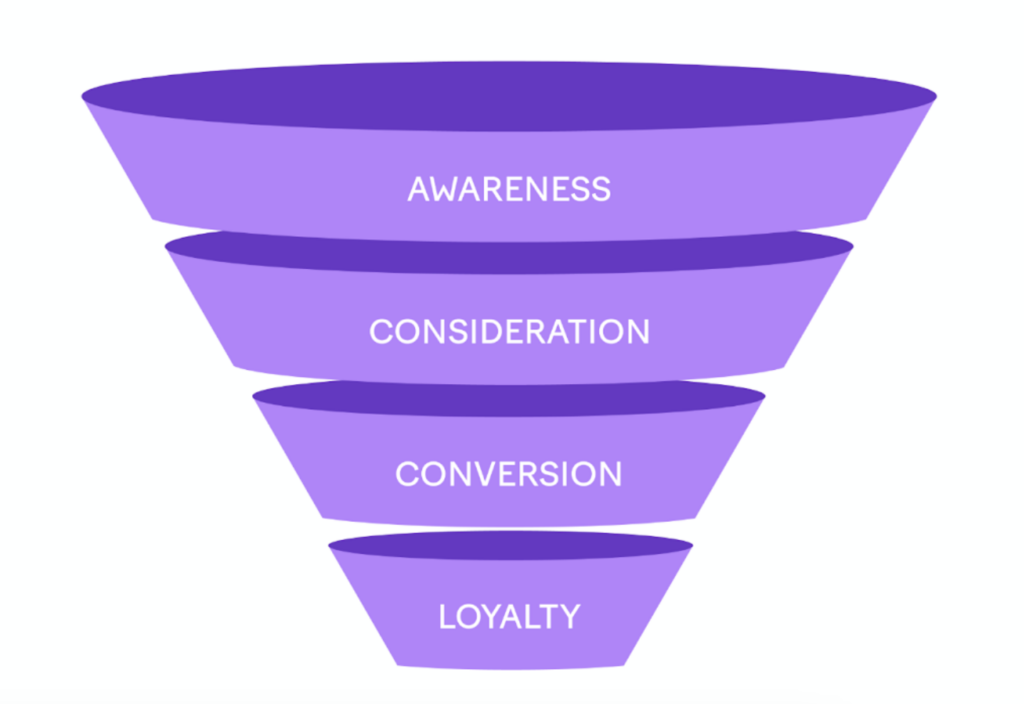
    Consider the ecommerce funnel:

    Within the funnel, paid ads and organic content work best at the Awareness stage, helping you capture attention and drive qualified traffic to your site. But here’s the truth: the real money is made in the next three stages—Consideration, Conversion, and Loyalty, and this is where email, SMS and app notifications take center stage. You need to earn the sale. Once you’ve paid to bring visitors to your site and they are considering your brand, you don’t want to lose them to a competitor. Email, SMS and notifications give you the tools to nurture that interest until they know, like and trust you enough to buy.

    And it doesn’t stop there. After they buy, these channels keep your customers engaged and your brand top-of-mind, build a lasting relationship, and turn that first sale into a steady stream of repeat orders, effectively increasing customer lifetime value (LTV). In other words, email and SMS don’t just complete the funnel—they multiply the return on every marketing dollar you spend. Furthermore, email marketing is also going to allow you to build a scalable, owned audience that compounds over time.

    The question is: would you rather keep pouring money into cold traffic… or spend far less to market to people who already know, like, and trust you? The truth is, you can’t scale efficiently—or profitably—if you’re not converting at a high rate on the backend.

    Email marketing is the most profitable channel for e-commerce brands—period. You pay for clicks through ads, capture visitor information when they land on your site, and then convert them on the backend with email. It may not be the latest flashy trend, but email remains the most reliable and profitable channel to consistently reach your customers right in their inbox.

    5 Reasons Email Marketing Dominates

    1. Permission-Based – Subscribers signed up because they are interested in hearing from you.
    2. Flexible – Educate, inspire, share stories, or promote offers—all in one channel.
    3. Direct – Skip the noise. Land straight in the inbox they check every day.
    4. Trackable – Measure opens, clicks, and conversions to sharpen your strategy.
    5. Affordable – Low costs + automation = sky-high ROI compared to other channels.
    6. Profitable – Build a scalable, owned audience that compounds over time.

    Email marketing is steady and reliable. It doesn’t depend on fleeting trends, changing algorithms, or the luck of going viral. When someone shares their email address, they’re granting you direct access—a personal connection that’s both powerful and lasting. Social platforms may come and go, but your email list is an asset you own. Unlike rented space on social media, every subscriber represents a direct connection you’ve earned.


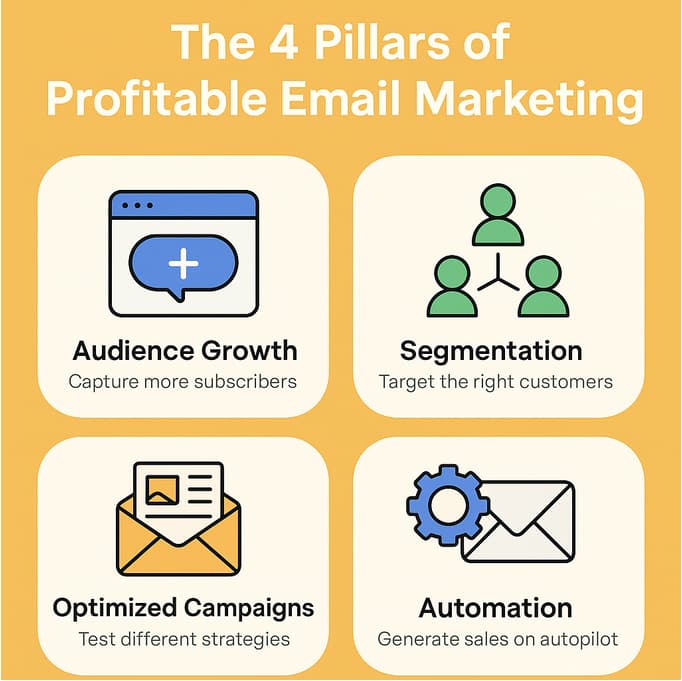
  • The 4 Pillars of Profitable Email Marketing (and Why They Drive 90% of Your Results)

    The 4 Pillars of Profitable Email Marketing (and Why They Drive 90% of Your Results)

    Email marketing is the most powerful revenue channel you own—but only if you approach it with the right strategy. Too many businesses treat email as a “send and hope” tool, blasting out promotions without a structure, and then wondering why results fall flat.

    The truth is, profitable email marketing is built on four non-negotiable pillars. These pillars separate the brands that see email as an afterthought from the ones that turn their lists into a predictable sales engine.

    In this post, we’ll break down the 4 Pillars of Profitable Email Marketing—so you can optimize every campaign, build lasting customer relationships, and unlock the full earning potential of your email list.

    While there are countless email marketing strategies you could experiment with, the reality is that 80% of your success will come from mastering just four core pillars:

    1. Audience Growth

    The bigger and better your email list, the more revenue you can generate—simple as that.
    The four primary list growth methods, ranked by importance, are:

    1. Popup Forms – The most powerful and scalable list growth tool. Every site visitor sees it, which means improving your popup conversion rate directly increases your revenue potential. Double your conversion rate, and over time, you’ll double your email revenue. Popups work better than any other method.
    2. Post-Purchase Opt-ins – Capture happy customers when they’re most engaged: after a purchase.
    3. Signup Pages – Standalone landing pages built solely for collecting subscribers.
    4. Signup Embeds – Static forms embedded into your site.

    Too many brands overlook popup forms because they seem “annoying”—but ignoring them means leaving money on the table.

    2. Campaigns

    Campaigns are one-time broadcasts sent to your list. They keep you top of mind with past customers—people who already know, like, and trust you.

    Unlike cold traffic, this audience is much cheaper to convert, making campaigns one of your most cost-effective traffic drivers.

    Best practices:

    • Send 2–4 campaigns per week (An A/B test is essential to determine the ideal number of campaigns to send to your list for maximum results with your brand.)
    • Balance content: educational, entertaining, and promotional.
    • Lead with value—nurture emails should outnumber hard sells.

    If your emails are relevant and well-designed, your subscribers will look forward to them. The goal is habit formation—getting customers in the routine of opening your emails so you’re always the first brand they think of when they’re ready to buy the products or services that you sell.

    3. Automated Flows

    Flows are triggered emails sent automatically when someone takes a specific action on your site—like joining your list, abandoning their cart, or making a purchase.

    Ideally, they should account for roughly 30-40% of your email revenue, with campaigns making up the other half.

    Why flows are essential:

    • Generate revenue on autopilot.
    • Convert high-intent visitors.
    • Recover lost sales.
    • Personalize the customer experience.
    • Reduce reliance on campaigns alone.

    Once set up, flows work around the clock to nurture leads and move customers through your buying journey.

    4. Segmentation

    Segmentation is a cornerstone of effective email marketing because it allows brands to send the right message to the right audience at the right time. By dividing subscribers into meaningful groups based on behavior, preferences, or lifecycle stage, marketers can make communications more relevant and engaging.

    Top benefits of segmentation:

    • Enhanced insights: Segmentation provides data to refine messaging and optimize campaigns.
    • Higher engagement: Personalized content leads to increased opens, clicks, and interactions.
    • Improved conversions: Targeted messaging drives purchases and repeat sales.
    • Stronger customer loyalty: Relevant emails foster trust and long-term relationships.
    • Better ROI: Resources are focused on the most receptive audiences, reducing wasted sends.

    Final Thoughts

    Email isn’t just alive—it’s thriving in today’s noisy digital world. And if you want to be profitable, you don’t need to chase every shiny new tactic. Focus on mastering the fundamentals—that’s where the real results come from.

    By focusing on list growth, campaigns, automated flows, and deliverability, you’ll have a high-performing email machine that drives consistent, scalable revenue—while keeping your customer acquisition costs in check.