Ecommerce is booming. Each year, fewer consumers shop in physical stores as the convenience of online shopping continues to fuel rapid growth. This trend shows no signs of slowing down.
With the ecommerce explosion, businesses now have more opportunities than ever to market their brand and drive targeted traffic to their websites through various platforms and strategies.
Such as:
- Social media
- User-generated content (UGC)
- Tik Tok
- Search Engine Optimisation (SEO)
- Word of Mouth Marketing
- Referrals
With countless ways to drive traffic and social media competing for every second of attention, it’s fair to ask: does email marketing still matter? The short answer is yes—now more than ever.
Email marketing consistently delivers one of the highest returns on investment (ROI) in digital marketing for most companies, and should be driving at least 30% of total revenue. While other strategies like social media ads, paid search, and influencer marketing can be effective, email stands out as the most outstanding and cost-efficient digital marketing channel for building relationships, driving conversions, and retaining customers. The table below highlights the average ROI per $1 spent compared to other common digital marketing strategies:
| Digital Marketing Channel | Average ROI per $1 Spent |
|---|---|
| Email Marketing | $36 – $42 |
| Search Engine Optimization (SEO) | $22 – $24 |
| Paid Search (Google Ads) | $2 – $4 |
| Social Media Advertising | $2 – $3 |
| Display Advertising | $1 – $2 |
| Influencer Marketing | $5 – $6 |
The bottom line is that paid ads, SEO, and other marketing strategies on their own can’t guarantee lasting success for e-commerce brands. SEO itself is shifting dramatically with the rise of AI-powered search experiences like Google’s SGE, while PPC costs continue to climb—forcing brands to spend more than ever just to get traffic. But traffic alone doesn’t pay the bills. The real challenge isn’t driving clicks; it’s turning those clicks into loyal, paying customers.
From Browsing to Buying: The Mindset of the Modern Consumer
Not long ago, buying online was often an impulsive decision — see a product, click, and purchase. But the modern consumer behaves very differently. Today, discovery is part of the experience, and browsing has become just as enjoyable as buying. In today’s crowded market, consumers are drowning in options—studies show that over 70% are willing to switch brands for a better deal or experience, making brand loyalty more fragile than ever. Social feeds are the new shopping mall, where shoppers bounce between 5–10 brands before making a decision.
With so many options and rising skepticism around online purchases, trust is no longer built in a single click. It now takes multiple touchpoints across multiple channels — email, social, reviews, UGC and retargeting — before a customer feels confident enough to convert. Ever heard of the Rule of 7? It’s the idea that a customer needs to encounter your brand at least seven times before committing to a purchase.
Furthermore, with online scams on the rise, today’s consumers are far more cautious—they won’t just click onto your site, trust you instantly, and make a purchase. That means most visitors leave without buying, forcing you to spend more on retargeting ads. The result? You often break even on your CAC (Cost of Acquisition) and first-purchase AOV (Average Order Value). In short, there’s little to no profit on the front end. This makes retaining your margins in the backend the #1 most important focus for surviving in this market.
|***If you’re not capturing attention, nurturing it, and turning it into sales, you’re simply burning cash.
Consider the ecommerce funnel:
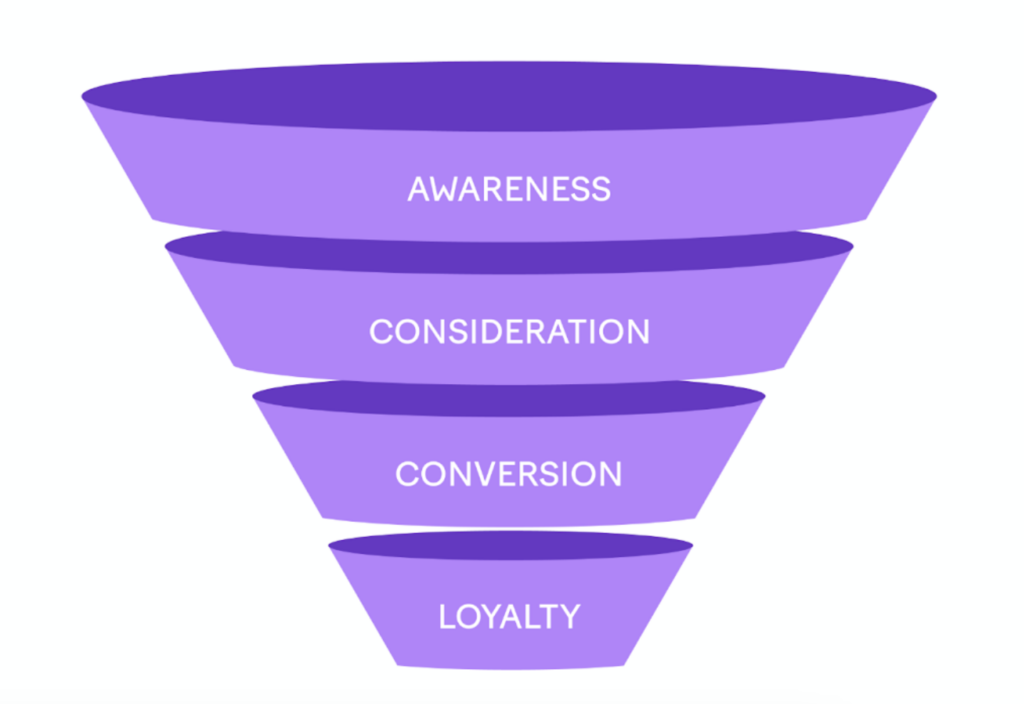
Within the funnel, paid ads and organic content work best at the Awareness stage, helping you capture attention and drive qualified traffic to your site. But here’s the truth: the real money is made in the next three stages—Consideration, Conversion, and Loyalty, and this is where email, SMS and app notifications take center stage. You need to earn the sale. Once you’ve paid to bring visitors to your site and they are considering your brand, you don’t want to lose them to a competitor. Email, SMS and notifications give you the tools to nurture that interest until they know, like and trust you enough to buy.
And it doesn’t stop there. After they buy, these channels keep your customers engaged and your brand top-of-mind, build a lasting relationship, and turn that first sale into a steady stream of repeat orders, effectively increasing customer lifetime value (LTV). In other words, email and SMS don’t just complete the funnel—they multiply the return on every marketing dollar you spend. Furthermore, email marketing is also going to allow you to build a scalable, owned audience that compounds over time.
The question is: would you rather keep pouring money into cold traffic… or spend far less to market to people who already know, like, and trust you? The truth is, you can’t scale efficiently—or profitably—if you’re not converting at a high rate on the backend.
Email marketing is the most profitable channel for e-commerce brands—period. You pay for clicks through ads, capture visitor information when they land on your site, and then convert them on the backend with email. It may not be the latest flashy trend, but email remains the most reliable and profitable channel to consistently reach your customers right in their inbox.
5 Reasons Email Marketing Dominates
- Permission-Based – Subscribers signed up because they are interested in hearing from you.
- Flexible – Educate, inspire, share stories, or promote offers—all in one channel.
- Direct – Skip the noise. Land straight in the inbox they check every day.
- Trackable – Measure opens, clicks, and conversions to sharpen your strategy.
- Affordable – Low costs + automation = sky-high ROI compared to other channels.
- Profitable – Build a scalable, owned audience that compounds over time.
Email marketing is steady and reliable. It doesn’t depend on fleeting trends, changing algorithms, or the luck of going viral. When someone shares their email address, they’re granting you direct access—a personal connection that’s both powerful and lasting. Social platforms may come and go, but your email list is an asset you own. Unlike rented space on social media, every subscriber represents a direct connection you’ve earned.
Leave a Reply