Category: Uncategorized

  • How to Properly Warm Up a New Sender Domain for Maximum Email Deliverability

    How to Properly Warm Up a New Sender Domain for Maximum Email Deliverability

    When you launch a new domain for sending marketing emails, you’re starting with a blank slate — and Internet Service Providers (ISPs) don’t yet know if you’re a trustworthy sender or a potential spammer. This is why a domain warm-up process is critical.

    Warming up your domain builds a positive sender reputation with ISPs, ensures your emails reach primary folders rather than spam folders, and lays the foundation for high engagement and conversions over time.

    Below, we’ll cover how to warm up your sender domain step-by-step, the best types of emails to send during this process, and proven strategies to maximize deliverability.

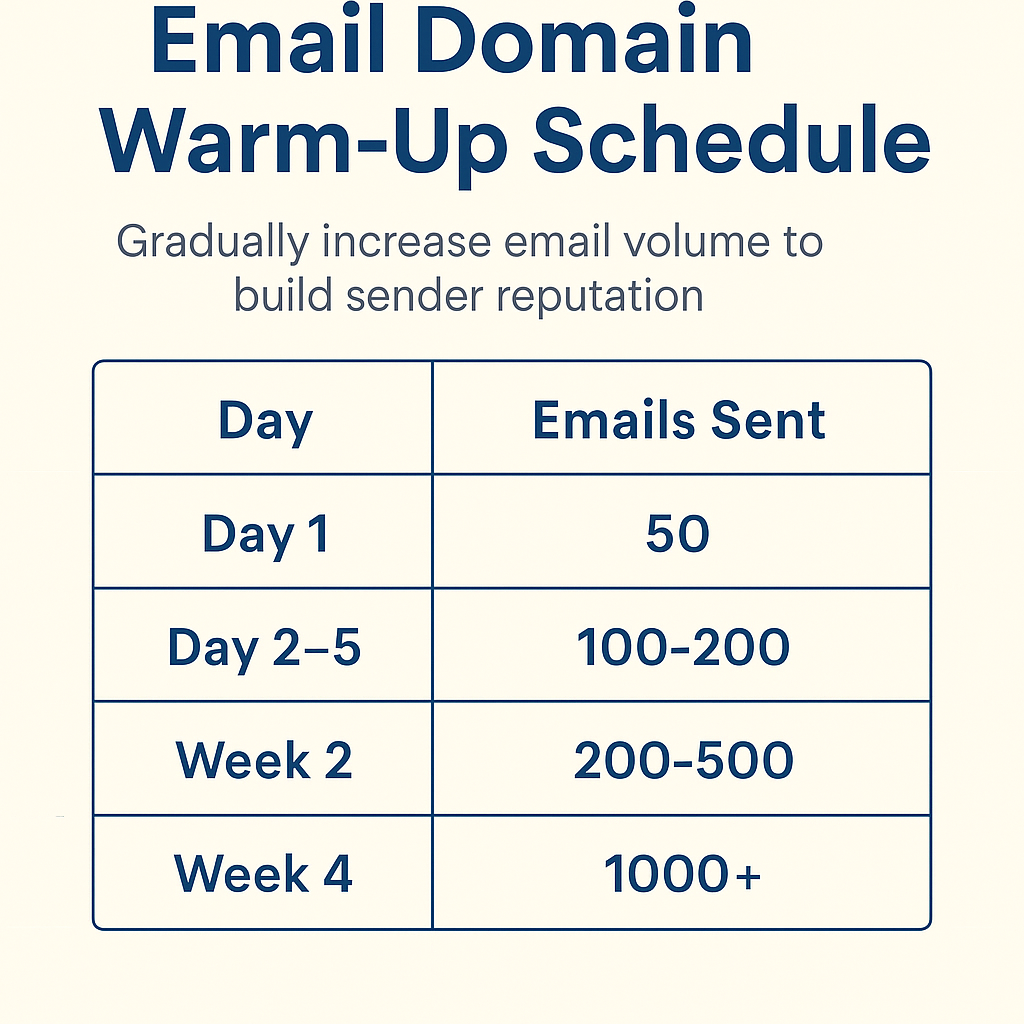
    Email Domain Warm-Up Schedule chart: Day 1, 50 emails; Days 2-5, 100-200; Week 2, 200-500; Week 4, 1000+. Gradual increase for reputation.

    Why Warming Up a Domain Matters

    ISPs like Gmail, Outlook, and Yahoo use sophisticated filters to protect users from spam. If your brand suddenly sends tens of thousands of emails from a new domain, the filters will in all likelihood flag you as suspicious — especially if recipients don’t engage.

    A proper warm-up:

    • Builds trust with ISPs
    • Improves inbox placement and open rates
    • Avoids blacklisting and sending restrictions
    • Strengthens domain and IP reputation for the long term

    Ramping

    Ramping is a process that aids in the overall warming process to become a reputable sender, whether you are using a dedicated or shared IP. Ramping involves starting out with smaller volumes of email sends, and then gradually increasing that volume over time.

    Step-by-Step Process to Warm Up a New Sender Domain

    1. Prepare Your Domain for Sending

    Before sending a single email:

    • Set up SPF, DKIM, and DMARC records for authentication
    • Ensure your domain name is professional, relevant, and not previously blacklisted
    • Verify your domain in your email service provider and Google Postmaster Tools
    • Create a subdomain for sending (e.g., mail.yourbrand.com) to separate marketing activity from your root domain

    2. Start with a Small, Highly Engaged Audience

    Begin by emailing only your most engaged subscribers — people who have recently interacted with your brand and are likely to open and click. This helps ISPs see positive engagement signals.

    Example:

    • Day 1 – Send to 50–100 of your most active subscribers
    • Day 2–5 – Gradually increase to 200–500 daily
    • Weeks 2–4 – Continue scaling, aiming to double or add 20–30% more each day
    • By Week 4–6 – You can typically send to your full list if engagement remains strong

    3. Send the Right Type of Emails During Warm-Up

    Your first emails should feel personal, valuable, and highly relevant to encourage opens and clicks. Avoid heavy promotions at first.

    Best warm-up email types:

    • Welcome Emails – Thank subscribers for joining, remind them what to expect
    • Exclusive Content – Send tips, guides, or behind-the-scenes stories
    • Survey or Feedback Requests – Encourage responses to drive interaction
    • Special Thank You Offers – Reward your most loyal subscribers with discounts
    • Brand Story Emails – Share your mission and values to build connection

    4. Maintain Consistency

    ISPs favor senders with predictable behavior.

    • Send at consistent times each day or week
    • Avoid large spikes in volume — sudden jumps can trigger spam filters
    • Keep your sending pattern steady, even after warm-up

    5. Monitor Engagement & Adjust

    During warm-up, track:

    • Open rates – Should be high in early days (over 40–50% for engaged lists)
    • Click rates – Positive clicks show ISPs your content is wanted
    • Spam complaints – Keep below 0.1% (Gmail flags senders above 0.3%)
    • Bounce rates – Aim to keep hard bounces below 1%

    If engagement drops or spam complaints rise, slow down your sending until metrics recover.


    6. Avoid Spam Triggers

    To prevent deliverability issues:

    • Avoid excessive use of promotional keywords in subject lines (e.g., “FREE,” “100% OFF”)
    • Keep your HTML clean and lightweight
    • Don’t send cold emails from your warm-up domain
    • Always include a clear unsubscribe link

    Proven Strategies to Build Trust with ISPs

    • Prioritize engagement over volume – A smaller list that engages is better than a massive unresponsive one
    • Use segmentation – Send different emails to different audience segments for higher relevance
    • Authenticate everything – SPF, DKIM, and DMARC setup is non-negotiable
    • Clean your list regularly – Remove inactive or bouncing addresses

    Conclusion

    Warming up your sender domain is a strategic, deliberate process that builds the foundation for long-term email marketing success. By starting small, sending high-value emails, and gradually scaling, you earn the trust of ISPs, avoid spam filters, and ensure your messages consistently land in the inbox.

    Done right, this process transforms your new domain from a blank slate into a trusted, high-reputation sender identity — which is the key to maximizing email ROI.

  • Spam Traps: The Hidden Threat That Can Destroy Your Email Reputation

    Spam Traps: The Hidden Threat That Can Destroy Your Email Reputation

    Email marketing can be one of the most profitable channels for any business—but only if you protect your sender reputation. One of the fastest ways to ruin that reputation is by falling into spam traps.

    If you’ve ever thought about sending cold emails, scraping emails from LinkedIn, or buying lists, think again. You might be walking straight into a trap designed to mark you as a spammer. Once you hit a spam trap, your domain and IP reputation can plummet overnight—and recovering from that can take months.

    Let’s break down what spam traps are, why they exist, how they work, and—most importantly—how to avoid them.


    What Exactly Is a Spam Trap?

    A spam trap is an email address created and monitored by anti-spam organizations, ISPs (like Gmail or Outlook), or even competitors to catch businesses that send unsolicited or non-permission-based emails.

    • Some traps are set up with fake LinkedIn profiles that look legitimate. You scrape the contact details, send a cold email, and instantly your domain is flagged.
    • Others come from fake websites built to look like real companies. You find the “contact us” email, send your pitch, and—again—you’ve hit a trap.
    • There are also recycled spam traps—old, abandoned email addresses that no longer belong to a real person but are reactivated by anti-spam groups to catch bulk senders who don’t maintain clean lists.

    Once your email hits a trap, the provider doesn’t just ignore you—it reports you. Google, Microsoft, Yahoo, and others see your sending behavior as spammy, and you get punished with poor deliverability.

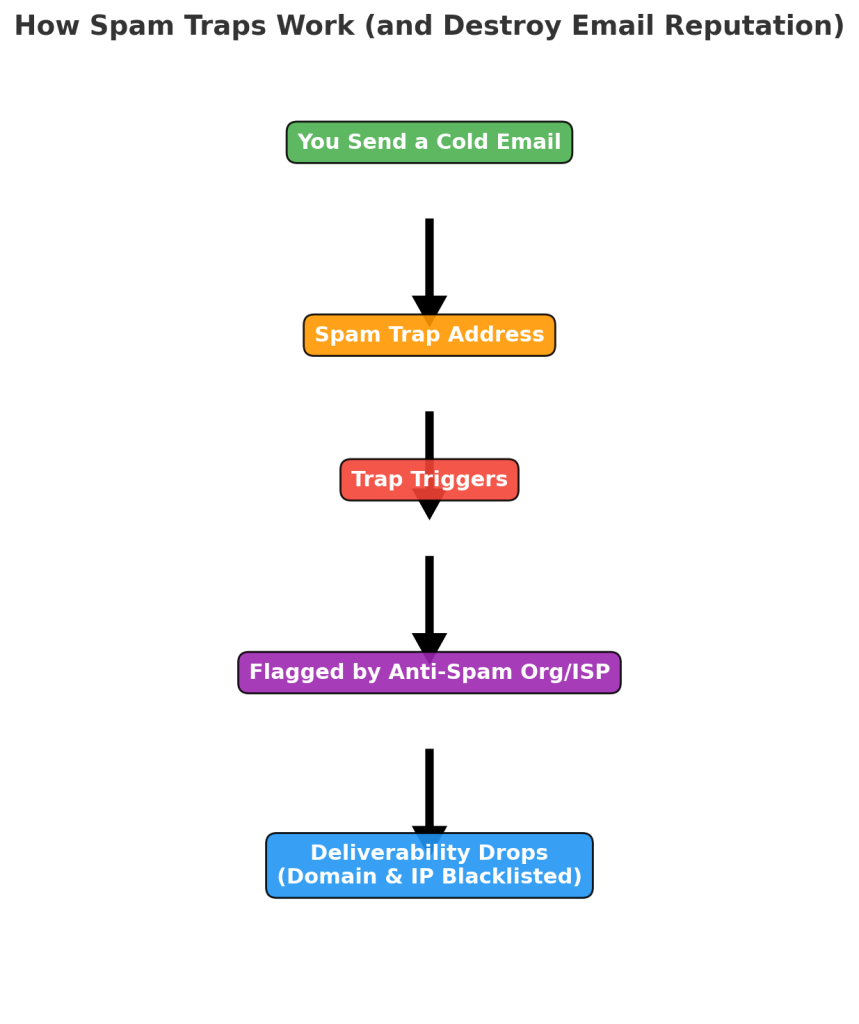
    Flowchart titled "How Spam Traps Work." Arrows connect boxes labeled: "Send a Cold Email," "Spam Trap Address," "Trap Triggers," "Flagged by Anti-Spam Org/ISP," "Deliverability Drops."

    Why Do Spam Traps Exist?

    Simply put: to protect consumers from unsolicited and low-quality emails.

    Inbox providers want to create a great experience for their users. Spam traps are their way of identifying senders who:

    • buy or scrape email lists.
    • send emails without consent.
    • neglect list hygiene and keep inactive addresses.

    If you’re flagged as a spammer, inbox providers push your emails to spam—or block them completely.


    The Impact of Hitting a Spam Trap

    Getting caught by a spam trap can destroy your sender reputation. The consequences include:

    • Deliverability drops – even engaged subscribers stop seeing your emails in their inbox.
    • Domain/IP blacklisting – once you’re on a blacklist, your emails may not be delivered at all.
    • Lost revenue – fewer emails in inboxes means fewer clicks, conversions, and sales.
    • Long recovery time – it can take months of effort (and sending restrictions) to repair a damaged reputation.

    How Businesses Accidentally Fall Into Spam Traps

    Many business owners fall into spam traps without realizing it:

    1. Scraping LinkedIn or directories
      → That “Marketing Manager” profile you scraped? It might be an anti-spam organization posing as a person.
    2. Cold emailing random company addresses
      → That “Contact Us” email might not belong to a real company at all. It could be a trap waiting for unsolicited emails.
    3. Neglecting list hygiene
      → Sending emails to old, inactive contacts is risky. Some of those addresses may have been converted into traps.
    4. Buying email lists
      → Purchased lists are notorious for being filled with spam traps—an almost guaranteed way to ruin your deliverability.

    How to Avoid Spam Traps

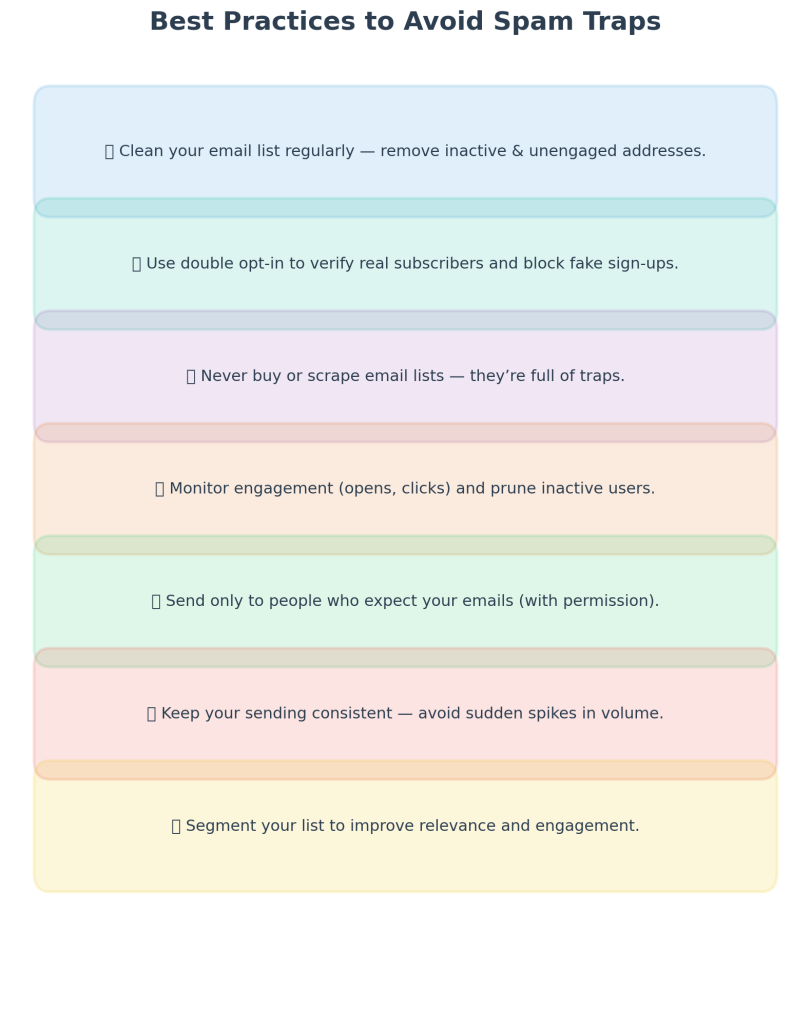
    "Colorful infographic titled 'Best Practices to Avoid Spam Traps,' showing tips like cleaning email lists, using double opt-in, monitoring engagement, and segmenting your list. The layout presents each tip in distinct color blocks."

    The good news? With the right practices, you can steer clear of traps and protect your sender reputation.

    1. Clean your list regularly

    Remove inactive subscribers who haven’t opened or clicked your emails in 60–90 days. Keep your list lean and engaged.

    2. Use double opt-in

    Double opt-in requires new subscribers to confirm their email before being added to your list. This ensures every address is valid—and keeps malicious competitors from adding traps to your newsletter.

    3. Never buy or scrape lists

    If you didn’t earn the email through sign-up, don’t use it. Purchased or scraped lists are the #1 way businesses get caught. Tools like ZeroBounce or NeverBounce can help identify risky emails.

    4. Monitor engagement metrics

    Inbox providers look at open rates, click rates, and spam complaints. If engagement drops, prune your list before traps start flagging you.

    5. Send only to people who want your emails

    This is the ultimate rule of email marketing: permission first. Always.


    Final Thoughts

    Spam traps are not random accidents—they are carefully designed to catch brands that don’t respect email best practices. Once you’re caught, your domain and IP reputation can collapse overnight.

    The safest path is simple:

    • Build your list organically.
    • Use double opt-in.
    • Keep your lists clean.
    • Send only to people who actually want your emails.

    Cold outreach may seem like a shortcut, but it’s not worth the risk. Email is too valuable a channel to lose by ste

  • Email Compliance 101: GDPR, CAN-SPAM, and CASL—What They Are and How to Stay on the Right Side

    Email Compliance 101: GDPR, CAN-SPAM, and CASL—What They Are and How to Stay on the Right Side

    If you collect emails and send marketing content, you’re handling personal data—and that comes with legal responsibilities. Following a few core rules keeps your list clean, your readers protected, and your sender reputation (and deliverability) safe. Below is a practical guide to the three major laws that govern marketing emails across much of the world: GDPR (Europe), CAN-SPAM (USA), and CASL (Canada)—what they are, who they apply to, the key requirements, and simple ways to stay compliant without the overwhelm.

    Quick note: This is general guidance, not legal advice. When in doubt, consult counsel.

    GDPR (Europe): Privacy-first marketing

    What it is:
    The General Data Protection Regulation is the EU’s comprehensive privacy law. It governs how you collect, store, and use personal data, including email addresses.

    Who it applies to:
    Any organization anywhere in the world that processes personal data of people in the EU/EEA (and, separately, the UK has a nearly identical regime). If you have EU subscribers, GDPR applies.

    Core marketing rules you should know:

    Lawful basis: You must have a legal reason to email. For marketing, that’s typically consent (clear, explicit opt-in) or legitimate interests (narrowly applied; document your balancing test).
    Consent standards: Freely given, specific, informed, and unambiguous. No pre-checked boxes. Make it as easy to withdraw consent as it was to give it.
    Transparency: Tell people exactly what they’re signing up for (who you are, what you’ll send, how often) and link your privacy notice.
    Data minimization & purpose limitation: Collect only what you need and use it only for stated purposes.
    Data subject rights: Be able to honor access, rectification, erasure, restriction, portability, and objection requests.
    Security & vendors: Protect data and have proper contracts (DPAs) with processors (e.g., your ESP).
    International transfers: If you move EU data abroad, use approved safeguards (e.g., Standard Contractual Clauses).

    Penalties: Significant administrative fines (potentially very large), plus reputational damage.

    How to comply (practical steps):

    Use double opt-in for EU lists; store timestamp, form URL, and IP as proof.
    Provide a clear unsubscribe in every email; honor removals promptly.
    Maintain a privacy policy that reflects your actual practices.
    Segment by region and apply stricter standards to EU/UK subscribers globally—it’s easier and safer.

    CAN-SPAM (USA): Honest, opt-out based rules

    What it is:
    The Controlling the Assault of Non-Solicited Pornography and Marketing Act sets rules for commercial email in the U.S. It is opt-out based (consent is not required to send, but robust opt-out is required).

    Who it applies to:
    Anyone sending commercial emails to U.S. recipients.

    Key requirements:

    Accurate headers & “From” lines: No deception about who’s sending.
    Truthful subject lines: No misleading copy.
    Identify the message as an ad where appropriate (unless your recipient has clearly opted in to receive marketing).
    Include a valid physical postal address.
    Clear, functioning unsubscribe in every message; honor within a short window (promptly).
    No selling/transferring of opted-out emails (except to a provider to comply).
    You are responsible for third-party senders working on your behalf.

    Penalties: Substantial fines per violating email, plus enforcement and ESP account risk.

    How to comply (practical steps):

    Always include physical address and a one-click unsubscribe.
    Don’t use deceptive subject lines or sender names.
    Maintain suppression lists and stop emailing unsubscribed contacts immediately.

    CASL (Canada): One of the strictest anti-spam laws

    What it is:
    Canada’s Anti-Spam Legislation is among the toughest. It requires consent (express or implied) before sending a commercial electronic message (CEM) to Canadian recipients.

    Who it applies to:
    Anyone sending CEMs to Canadian recipients, regardless of sender location.

    Key requirements:

    Consent first:
        Express consent (ideal): clear opt-in, no pre-checked boxes.
        Implied consent: narrow windows (e.g., existing business relationship up to a defined period after purchase; inquiries within a shorter period). Track expiry dates.
    Identify yourself: Include your business name and contact info (mailing address and either phone, email, or web address).
    Unsubscribe mechanism: Simple, free, works for at least 60 days after sending; process requests quickly (within days).
    Record-keeping: Maintain proof of consent and when/how it was captured.

    Penalties: Significant administrative monetary penalties, plus severe deliverability consequences.

    How to comply (practical steps):

    Favor double opt-in in Canada and track consent type (express vs implied) with dates.
    Automate implied-consent expiry rules—convert to express, or stop emailing when the window closes.
    Include required identity details and unsub link in every send.

    A unified, low-stress way to stay compliant (without getting overwhelmed)

    If your list is global, the simplest operational approach is to set your standards to the strictest common denominator and automate the rest:

    1) Consent & capture

    Use double opt-in on all signup sources (popups, landing pages, checkout opt-ins).
    Store proof of consent (timestamp, source URL, IP).
    Avoid purchased or scraped lists—they’re consent landmines and deliverability killers.

    2) Clarity & transparency

    Clearly state what subscribers will receive and how often.
    Link your privacy policy on forms and in footers.
    Use plain, truthful subject lines and accurate sender names.

    3) Every email footer, every time

    Business identity (name)
    Physical postal address
    One-click unsubscribe that works instantly
    Optional: preferences center to reduce unsubscribes

    4) List hygiene & suppression

    Remove hard bounces and persistent soft bounces.
    Honor unsubscribes immediately and maintain suppression lists.
    Sun-set non-engagers (e.g., no opens/clicks in 90–120 days), and run re-engagement before removal.

    5) Segmentation by jurisdiction

    Tag subscribers by country/region at signup (self-selection or geo-IP) to apply regional rules (e.g., CASL implied-consent timers).
    When unsure, apply GDPR-level consent as your default.

    6) Vendor & security basics

    Send via a reputable ESP with authentication (SPF/DKIM/DMARC) and robust suppression handling.
    Sign DPAs where needed and secure data access internally.

    7) Process the rights requests

    Have simple internal playbooks to handle access, deletion, and unsubscribe requests promptly.

    Compliance cheat-sheet (printable)

    ✅ Get consent (double opt-in preferred; track proof).
    ✅ Be transparent (who you are, what you’ll send, how often).
    ✅ Unsubscribe + address in every email.
    ✅ No deceptive headers/subjects.
    ✅ Clean your list and honor opt-outs immediately.
    ✅ Segment by region and apply stricter rules by default.
    ✅ Don’t buy or scrape lists.
    ✅ Document your process (it impresses auditors—and your ESP).

    Do these consistently and you’ll not only stay compliant—you’ll also improve deliverability and trust, which translates directly into better inbox placement and higher revenue from email.

  • How to Make VIP Customers Feel Special (and Why It’s the Secret to Driving Loyalty & Sales)

    How to Make VIP Customers Feel Special (and Why It’s the Secret to Driving Loyalty & Sales)

    Not all customers are created equal. While every buyer matters, a certain segment—your VIP customers—contributes disproportionately to your revenue, growth, and long-term success. Treating these customers like just another name on your email list is a costly mistake. Instead, brands should intentionally identify, segment, and strengthen relationships with their most valuable customers through recognition and exclusive benefits to build loyalty and maximize lifetime value. The good news? With the right strategy, automation and personalization, you can design a powerful VIP program that makes your best customers feel truly special while driving significant sales growth.
    What Are VIP Customers?

    VIP customers are the small percentage of your audience who generate the majority of your revenue. They’re your high-CLV power buyers—loyal repeat customers who purchase frequently, spend more per order, and actively engage with your brand because they know, like, and trust you. These are the people who consistently fuel your growth and are most likely to keep doing so in the future. In other words, they are your most valuable segment—the customers you absolutely cannot afford to lose.
    The Power of VIP Flows in Loyalty Programs

    VIP flows are the backbone of a loyalty program strategy, designed to reward and retain your biggest spenders. These flows should start by alerting shoppers when they’re getting close to qualifying for your VIP community. This early notification builds anticipation and motivates them to take the final step that unlocks exclusive perks.

    Sample Pre-VIP Message:
    “You’re just $25 away from unlocking VIP status! As a VIP, you’ll gain access to exclusive deals, early product drops, and special rewards reserved only for our top customers. One more purchase and you’re in!”

    Once a customer qualifies, they enter a VIP-specific welcome series that sets the tone for their new relationship with your brand. This series explains the benefits, highlights what they can expect from the program, and delivers their first set of VIP rewards—whether that’s a unique discount, free shipping, or early access to limited editions.

    By celebrating milestones and unlocking new rewards over time, VIP flows delight top shoppers and encourage repeat spending. This gamifies the shopping experience, making it fun to engage with your brand, spend more, and look forward to unlocking the next incentive. The result? Higher retention, stronger loyalty, and a community of customers who feel truly valued.
    How to Define VIP Customers

    Every brand must determine its own criteria for what qualifies as a VIP. The two most common approaches are:

    Number of Purchase Orders – Customers who make frequent repeat purchases.
    Total Order Value – Customers who spend significantly more than the average buyer.
    A Combination of Both – The most effective approach, as it ensures you’re rewarding both high-frequency buyers and high-value spenders.

    For example, if your average customer places 2 orders per year worth $100 each, a VIP might be defined as someone who places 5+ orders annually or spends $500+ in a given timeframe.
    Provide Cross-Sell or Upsell Opportunities

    As you build automations to engage your VIP shoppers, leverage their past order history to shape a messaging strategy that feels personal and relevant.

    Two of the most effective tactics are cross-selling and upselling. Cross-sells expand what customers buy, while upsells elevate what they buy—both are powerful when fueled by past order history in your VIP flows.

    Cross-Sell
    Use purchase history to recommend complementary products that naturally pair with what they’ve already bought.
        Examples: Suggest related items, highlight bundles frequently purchased together, share blogs or guides showcasing how products work in tandem, or send personalized recommendations of what they’re likely to enjoy next.
    Upsell
    Encourage your VIPs to upgrade to more premium, higher-value versions of products they already love.
        Examples: Showcase premium or add-on versions, offer upgrade incentives or discounts, highlight higher-tier or subscription-based options, or provide educational content that demonstrates the benefits of upgrading.

    Cross-Sell vs. Upsell for VIP Customers
    Strategy Definition Examples Goal
    Cross-Sell Recommend complementary products based on past purchases. – Suggest accessories or add-ons (e.g., shoes with a dress).
    – Showcase bundles others bought together.
    – Share blog posts/guides linking related products. Increase average order value by adding more items to the cart.
    Upsell Encourage purchase of a higher-value version of a product they already love. – Promote premium or luxury versions.
    – Offer subscription upgrades.
    – Provide educational content highlighting benefits of the upgrade. Boost revenue per order by moving customers toward premium tiers.

    By tailoring your automations this way, you not only increase order value but also make your VIPs feel understood and rewarded with offers that truly match their preferences.
    Steps

    1. Identify and Segment Top Customers Define criteria: Use data such as lifetime spending, purchase frequency, engagement with emails/socials, referrals, and customer longevity to rank your top tier.
      Dynamic segmentation: Continuously update this segment so that it reflects real-time engagement, ensuring only the most loyal customers are included.
      Use advanced metrics: Go beyond simple purchase data—consider customer advocacy (reviews, referrals, UGC) and responsiveness to promotions.
    2. Craft Exclusive Communications Dedicated channel: Create emails, SMS, or app notifications designed specifically for VIPs, with a distinct look and tone that makes them feel different from standard communications.
      Personalized messaging: Use their name, purchase history, and preferences to tailor offers. Highlight that they are receiving something not available to others.
      Storytelling: Share behind-the-scenes content, sneak peeks, or brand updates that strengthen their sense of being “in the inner circle.”
    3. Explicit Recognition of VIP Status Subject lines and headers: Examples — “Because You’re One of Our Top 1%,” “Your VIP Status Unlocks This,” or “Andre, Here’s Your Early Access.”
      Badging and branding: Add a visible “VIP” label in emails, account dashboards, or loyalty apps. Create a special design element that signals exclusivity.
      Tone of appreciation: Reinforce gratitude consistently—acknowledge that their loyalty is key to the brand’s success.
    4. Offer Premium Perks and Benefits Early access: Let them shop new collections, sales, or drops before the public.
      Exclusives: Limited-edition products, VIP-only bundles, or member-only events (virtual or in-person).
      Elevated service: Priority customer support, free shipping upgrades, extended return windows, or access to personal shopping/consultation services.
      Surprise & delight: Send unexpected perks like handwritten notes, free gifts, or birthday/anniversary treats.
    5. Foster Ongoing Engagement Gamify status: Show progress toward maintaining or unlocking higher VIP levels (like silver, gold, platinum tiers).
      Solicit feedback: Ask VIPs for input on upcoming launches or features—making them feel like co-creators.
      Exclusive communities: Create private groups, forums, or events where VIPs can connect with the brand and each other.
    6. Measure & Optimize Track engagement lift: Compare VIP customer behavior against the broader audience.
      Test & refine perks: Experiment with offers to see which benefits resonate most.
      Retention focus: Ensure communications continue to feel fresh, valuable, and rewarding so VIPs don’t disengage.

    👉 In short: Identify → Recognize → Reward → Engage → Optimize.
    This framework turns VIP status from a simple marketing tactic into a powerful long-term relationship-building strategy.Creating a VIP Segment

    Once you’ve defined what makes a VIP customer, the next step is building a dedicated segment in your email marketing platform. This segment should update automatically, so every customer who meets your criteria is added in real time. This allows you to target them with personalized messaging and exclusive offers the moment they enter VIP status.
    Designing a VIP Automated Flow

    To truly make VIP customers feel special, build a dedicated automated flow for them. This flow should include:

    A Warm Welcome to the VIP Club – Send a personal thank-you message acknowledging their loyalty and highlighting the benefits of being part of your VIP tier.
    Exclusive Offers – Share early access to new products, limited-edition items, or exclusive discounts only available to VIPs.
    Insider Content – Give them behind-the-scenes looks, sneak peeks, or founder’s notes to make them feel like insiders.
    Milestone Celebrations – Recognize special moments, like their 5th purchase, spending milestones, or even birthdays, with personalized rewards.
    Loyalty Rewards – Offer referral bonuses, free gifts, or double loyalty points for continued purchases.
    Feedback Solicitation – Automated surveys, personalized outreach.

    VIP Flow Framework
    Flowchart titled “VIP Flow Framework: From Pre-VIP to Milestone Celebrations” with five colorful steps: Pre-VIP Alert, VIP Welcome, VIP Onboarding Series, Ongoing VIP Perks, and Milestone Celebrations, each with a specific trigger and goal.

    Pre-VIP Alert (Threshold Reminder)

    Trigger: Customer approaches the VIP threshold (e.g., 90% of required spend or points).
    Message Goal: Motivate them to complete the final step.
    Example Copy:
    “You’re just $25 away from unlocking VIP status! Complete your next order and gain access to exclusive rewards reserved for our best customers.”
    1. VIP Welcome Email (Trigger: Customer enters VIP segment)

    Subject line ideas:

    “Welcome to the Inner Circle, [Name] ✨”
    “Because you’re one of our best — you’ve unlocked VIP status”

    Content structure:

    Warm recognition: “We couldn’t do this without customers like you. You’re officially one of our top supporters, and we’re thrilled to welcome you into our VIP circle.”
    Badge of honor: Introduce their VIP status and what it means (early access, exclusives, perks).
    Call-to-action: Link to a dedicated VIP landing page where benefits are clearly outlined.
    Surprise element: Optionally include a welcome gift or discount code.
    1. Ongoing Recognition Email (Monthly or Quarterly)

    Subject line ideas:

    “Your VIP perks are waiting, [Name]”
    “Because loyalty deserves something special…”

    Content structure:

    Highlight perks: Showcase what’s available this month (exclusive items, early access).
    Personalization: Use purchase history — e.g., “Since you loved [product], we thought you’d enjoy…”
    Engagement nudge: Invite them to participate in surveys, beta testing, or community events.
    Gratitude tone: Reiterate appreciation and remind them their loyalty is noticed.
    1. Early Access / Exclusive Drop Email (Campaign-driven)

    Subject line ideas:

    “VIP First Look: Shop [Product/Collection] Before Anyone Else”
    “Your private access code inside 🔑”

    Content structure:

    Clear exclusivity: “This isn’t available to the public yet—only to our VIPs like you.”
    Scarcity: Highlight limited quantities or limited-time access.
    CTA: Bold button (e.g., “Shop First,” “Unlock Access”).
    Visuals: Premium, polished design that stands apart from regular promos.
    1. Surprise & Delight Email (Occasional, unexpected)

    Subject line ideas:

    “A little thank you, just for you ❤️”
    “Because you’ve been amazing…”

    Content structure:

    Gift or perk: Free upgrade, free shipping, bonus product, or birthday reward.
    Emotional connection: Keep it short and warm: “We see you, we appreciate you, and we wanted to give back.”
    CTA (optional): Link to shop or just let them enjoy the gift with no strings attached.
    1. VIP Renewal / Retention Email (Yearly or after X months)

    Subject line ideas:

    “Your VIP status continues 🎉”
    “Here’s to another year of loyalty + rewards”

    Content structure:

    Recap benefits: Remind them of all the perks they’ve enjoyed.
    Acknowledgment: Share how much they’ve contributed (e.g., “You’ve been with us for 3 years,” or “You’re in our top 1% of customers”).
    Future perks: Tease upcoming exclusives to keep excitement high.
    CTA: Encourage continued engagement (e.g., “See what’s next”).

    👉 Together, these create a VIP lifecycle journey that welcomes, nurtures, excites, and retains your best customers.

    Rachel Riley’s VIP engagement email rewards top customers with exclusive early access to the Memorial Day sale. Through smart segmentation, the brand identifies its most loyal shoppers and delivers a tailored experience designed just for them.
    Two children on a boat hold American flags under a bright sky, surrounded by red, white, and blue decorations. Text promotes a Memorial Day sale.

    The bold headline — “VIP ACCESS TODAY ONLY” — instantly creates urgency, while the generous 40% discount reinforces the exclusivity of the offer. The copy is upbeat and concise, supported by a single, compelling call-to-action (“Shop Now”) that drives immediate clicks.

    Visually, the email ties into the holiday with patriotic imagery and children styled in branded outfits, keeping the focus on both the occasion and the product line.

    By offering first choice on limited inventory, Rachel Riley not only incentivizes quick action but also strengthens customer loyalty, making VIP subscribers feel recognized and privileged.

    ⚡ Pro Tip: Add dynamic segmentation so that perks scale with spend—turning your loyalty program into an ongoing game that customers want to keep playing.
    Emails to Keep VIP Customers Engaged

    Your VIP emails should differ significantly from your standard campaigns. These customers don’t just want another coupon—they want recognition and exclusivity. Consider including:

    Personalized thank-you messages from the founder or team
    Early-bird access to product launches or seasonal sales
    Invitations to limited-time events, webinars, or communities
    Free gifts, samples, or exclusive bundles
    Surveys asking for feedback on new products (making them feel part of the brand’s growth)

    Creative Ways Engage Your VIP Community
    Four colorful blocks describe ways to engage a VIP community: Spark Conversations, Surprise & Delight, Run Contests & Challenges, Spotlight Your VIPs.

    Spark Conversations: Invite VIPs to start discussion threads, share experiences, or even contribute guest blog posts to showcase their voice.
    Surprise & Delight: Add unexpected joy with spin-the-wheel discounts, bonus rewards, or exclusive gifts that make members feel special.
    Run Contests & Challenges: Host fun competitions on your community page—like photo contests, quizzes, or referral challenges—to encourage participation and excitement.
    Spotlight Your VIPs: Re-share VIP videos, testimonials, and user-generated content to recognize their contributions and reinforce that their time and loyalty matter.

    The tone should always be warm, appreciative, and exclusive—making them feel part of an inner circle.
    Adding VIP Messages to Your Content Calendar

    Your VIP program deserves messaging that goes beyond the ordinary. Every communication should reinforce the exclusivity and value of membership, using language that makes VIPs feel like insiders with access to privileges no one else can claim. The tone should celebrate their loyalty and highlight their importance to your brand.

    When planning VIP messages in your content calendar, consider:

    Frequency: Decide how often you’ll communicate (weekly, monthly, or quarterly) and keep it consistent so members know when to expect your updates.
    Content Focus: Plan unique content tailored to VIPs, such as exclusive sales, early product launches, member spotlights, or behind-the-scenes updates.
    Strategic Goals: Align each message with a clear outcome—whether it’s driving revenue, boosting referrals, encouraging repeat purchases, or building anticipation for new product adoption.

    By intentionally scheduling VIP messages with clear goals, consistent cadence, and exclusive content, you’ll not only engage your top customers but also strengthen the sense of prestige that keeps them loyal.

    Here’s a Quarterly VIP Content Calendar Example (12 weeks) infographic, showing a rotating cadence of offers, spotlights, product drops, contests, and surprise perks—keeping VIP messaging fresh and consistent across an entire quarter.
    A 12-week VIP content calendar with colored blocks. Weeks are labeled with activities like ‘Exclusive Sale,’ ‘Member Spotlight,’ and ‘Surprise Perk.’
    The Role of A/B Testing

    Even with VIPs, there is no one-size-fits-all approach. A/B testing should play a central role in refining your VIP communications. Test elements like:

    Subject lines (e.g., “A Gift for Our Best Customers” vs. “Exclusive VIP Reward Inside”)
    Incentive types (e.g., free shipping vs. free gift vs. percentage-off discount)
    Content formats (e.g., storytelling-style founder emails vs. polished product showcases)
    Timing and frequency of VIP emails

    The goal is to identify what resonates most with your highest-value customers without overwhelming them. Small tweaks can dramatically increase engagement and retention in this critical segment.
    Final Thoughts

    Your VIP customers are not just buyers—they’re brand advocates, repeat purchasers, and the lifeblood of your long-term profitability. By defining who they are, creating a dedicated segment, and building automated flows designed to celebrate and reward them, you strengthen loyalty and encourage even higher lifetime value. Pair this with consistent A/B testing, and you’ll ensure your VIP program continues to evolve and deliver results. In short: treat your VIPs like the special customers they are, and they’ll reward you with loyalty that fuels your brand’s growth for years to come.
  • Why Unsubscribes Aren’t Always a Bad Thing (and When They Signal a Content Problem)

    Why Unsubscribes Aren’t Always a Bad Thing (and When They Signal a Content Problem)

    When brands see unsubscribes roll in, the first reaction is often panic. “We’re losing our audience!” But the truth is, unsubscribes aren’t always a bad thing. In fact, they can be a sign of a healthy email marketing strategy, one that is actively filtering out the people who were never your true audience to begin with. The key is knowing when unsubscribes are simply part of the process—and when they’re warning signs that your email marketing strategy may need attention.

    List Hygiene

    Not every unsubscribe is a failure. In many cases, they represent natural and even beneficial churn:

    • They were never your ideal subscriber. Some people opt in impulsively but were never truly aligned with your brand. Perhaps a subscriber simply joined to get your discount, and that’s fine.
    • They’re no longer interested in the theme. People’s tastes, lifestyles, and needs change over time, making previously relevant content less appealing.

    These unsubscribes are actually healthy. They keep your list cleaner, more engaged, and free of dead weight. And that matters because smaller, more engaged lists:

    • improve deliverability rates (your emails are less likely to hit spam).
    • reduce marketing costs (you’re not paying for inactive subscribers).
    • provide clearer, more accurate engagement data.

    Key benchmarks for unsubscribe rates:

    • 0% to 0.5%: Excellent range, considered industry best practice.
    • 0.5% to 1%: Acceptable range, but may require some fine-tuning.
    • Above 1%: Needs attention: evaluate your strategy.

    Message Fatigue: Misaligned Campaigns and Flows

    One common cause of high unsubscribe rates is a lack of consistency in when and how often you email — and it usually stems from poor coordination between flows and campaigns. Without proper alignment, subscribers may receive multiple emails within a few days or even hours: campaign emails hitting their inbox at the same time as automated flows (such as browse abandon or site abandon) triggered by their activity on your site. This overlap not only creates redundancy but also overwhelms subscribers, making it more likely that they will disengage or unsubscribe. You can avoid this with smart sending in Klaviyo when sending out your campaigns.

    What is Smart Sending?

    Smart Sending allows you to limit how many emails, SMS messages, or push notifications a subscriber can receive from you within a defined timeframe. This safeguard ensures that your audience isn’t overwhelmed with too many messages at once — especially important if you’re running multiple automated flows alongside regular campaigns. By using smart sending, you protect your subscriber experience, reduce fatigue, and lower the risk of unsubscribes while still keeping your messaging effective.

    Using Unsubscribes as Feedback

    Unsubscribes also offer valuable insight into how your content is landing. A simple strategy is to include an unsubscribe survey or checklist when someone opts out. Options might include:

    • Too many emails
    • Content not relevant
    • Prefer to follow on social
    • Not interested anymore

    This data helps you separate healthy churn from unhealthy churn and gives you practical feedback for improvement.

    When Unsubscribes Are a Sign of a Problem

    Unsubscribes only become a problem when they reveal cracks in your content strategy. If your ideal subscribers are steadily unsubscribing because:

    • your emails are irrelevant to their needs;
    • you’re overwhelming them with constant “buy, buy, buy” messages;
    • the tone of your emails feel robotic, generic, or insincere;

    Then unsubscribes are a symptom of a deeper issue—you don’t fully understand your audience.

    What Your Ideal Subscriber Actually Wants

    To avoid unhealthy churn, brands must first define their ideal subscriber persona—their ideal customer. That means understanding their interests, preferences, challenges, goals, and why they’d want your products. When you write to this person, you’re not guessing; you’re speaking directly to someone who cares about your brand.

    Your ideal subscriber wants:

    • Relevant and engaging content that speaks to their needs, not generic blasts.
    • Balance. Offers are fine—but they don’t want endless pushy sales pitches.
    • Human connection. Your subscribers want to feel like a real person is writing to them, not a marketing robot or AI. Casual, funny, or even slightly weird works—as long as it shows personality.
    • Optimise for mobile. The majority of emails today are opened on mobile devices, and how your message renders can vary depending on the recipient’s email client. Mobile optimization isn’t optional anymore; it’s the baseline for delivering a seamless subscriber experience.
    • Tailor Your Content for your audience. Every subscriber should feel like an email was written just for them. Rather than blasting a one-size-fits-all newsletter to your entire list, segment your audience and customize content based on demographics, preferences, or past behavior. For example, create different themes or product highlights for distinct groups so that each recipient receives messaging that speaks directly to their interests. Personalization not only reduces unsubscribes, but increases engagement and strengthens the relationship between your brand and your subscribers.
    • Consistency. Random blasts don’t build trust. Predictable rhythm does. Whether it’s once a week or twice a week, showing up reliably builds confidence.
    • Respect. No spam. No guilt-tripping. No fake scarcity tricks. Treat the inbox like you were invited, not entitled.

    Healthy vs. Unhealthy Unsubscribes

    Type of UnsubscribeWhy It HappensWhat It Means for Your BrandAction Needed
    Healthy UnsubscribesSubscriber got what they needed (e.g., a discount), lost interest in the topic, or wasn’t your ideal customer to begin with.Normal list churn; keeps your list clean, engaged, and cost-efficient.None (these are expected). Focus on nurturing those who stay.
    Unhealthy UnsubscribesContent is irrelevant, emails are too frequent or too sales-heavy, tone feels robotic, or there’s no consistency.Signals a gap in your content strategy and weak understanding of your ideal subscriber.Review your content strategy, refine your subscriber persona, and A/B test messaging, tone, and frequency.

    Final Thoughts

    Unsubscribes aren’t the enemy—they’re information. Healthy unsubscribes clean up your list and sharpen your focus. But if you’re losing subscribers because your emails are irrelevant, robotic, or inconsistent, it’s a wake-up call that your content strategy needs work. When you understand your ideal subscriber, create content that resonates with them, and show up with consistency and respect, you’ll turn unsubscribes from something to fear into a powerful tool for building a stronger, more loyal audience.

  • Stop Chasing Numbers: How to Build an Email List Full of Ideal Customers

    Stop Chasing Numbers: How to Build an Email List Full of Ideal Customers

    Building a successful e-commerce business isn’t just about driving traffic—it’s about capturing and nurturing that warm traffic into loyal, long-term customers. And the most effective way to do that is by growing your email list.

    Why Growing Your Email List Is Critical

    List growth is the most important, yet overlooked part of email and SMS marketing. It has a ripple effect on your email marketing—it’s the lead domino that influences every metric in the funnel. In fact, the rate at which your list grows often determines the whole tracterory of your brand’s email marketing success.

    Driving traffic today is more expensive than ever. Between rising ad costs, increasing competition, and shrinking attention spans, brands are paying more just to get visitors onto their site. Yet, less than 2% of first-time visitors will convert into buyers. That means the overwhelming majority of the people you’ve paid to bring to your site will leave without ever buying, never to return.

    The solution isn’t to push harder for a first-time sale—it’s to capture their email address. By doing so, you can build a relationship, provide value over time, and nurture them into becoming not just customers, but loyal advocates for your brand. If you’re not capturing attention, nurturing it, and turning it into sales, you’re simply burning cash.

    Your website’s goal should be more than “make the sale.” It should be: convert visitors into subscribers. Because even if someone does buy the first time, that doesn’t automatically make them a loyal customer. The real power lies in building an ongoing connection—and email is the cheapest, most reliable, and profitable way to do it.


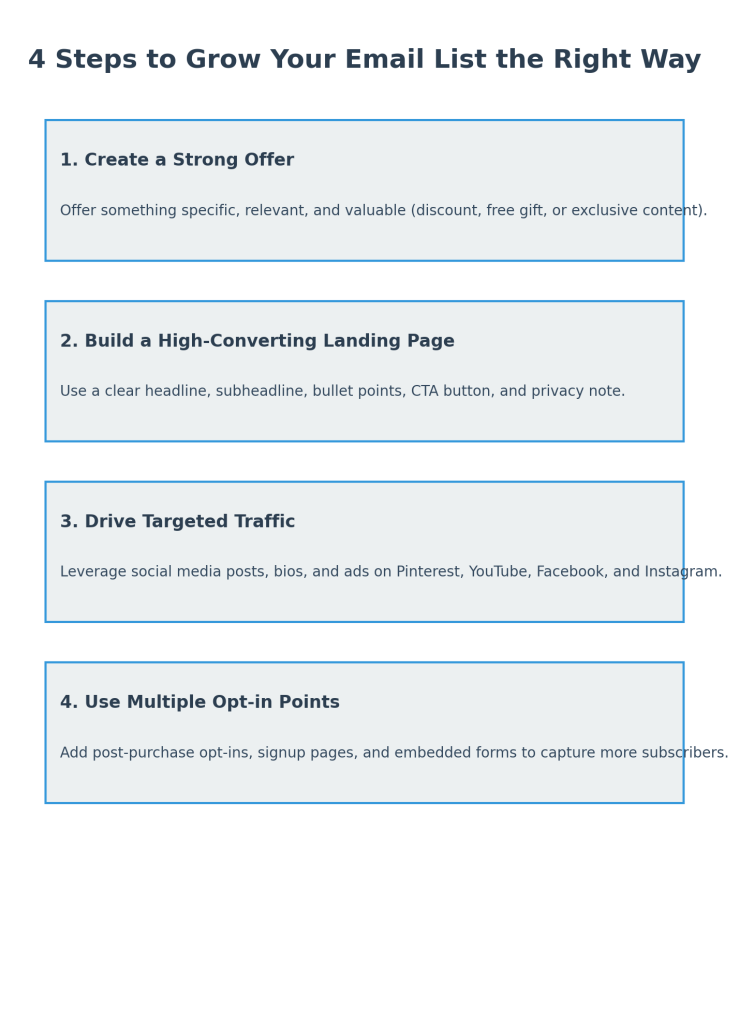
    Here are proven steps you can take to attract the right subscribers and build an email list filled with your ideal customers.

    Step 1: Create a Strong Offer to Attract Ideal Subscribers

    Not all incentives are created equal. Just because you’re offering something of value doesn’t mean your ideal subscriber will find it compelling enough to hand over their email.

    A strong offer is:

    • Specific: It clearly communicates the value. (“Get 15% off your first skincare set” is better than “Sign up for updates.”)
    • Relevant: It aligns with your ideal subscriber’s needs and desires.
    • Valuable: It feels like a real win, not a throwaway.

    Common examples include:

    • A percentage discount (10–20% off is typical for e-commerce).
    • Free shipping on the first order.
    • A free gift with purchase.
    • An exclusive piece of content or resource (e.g., style guide, recipe ebook, skincare routine template).

    Remember: This is your first impression. The offer will often be the difference between someone subscribing or bouncing. Make it irresistible.


    Step 2: Build a High-Converting Landing Page

    Once you have a strong offer, you need a landing page designed to capture emails effectively. A good landing page includes:

    • Headline: A bold promise that immediately communicates the benefit.
    • Subheadline: Adds clarity and context to the offer.
    • Bullet Points: Short, scannable benefits that reinforce the value.
    • CTA Button: A strong, clear call-to-action (“Join & Save 15%”).
    • Privacy Note: Reassures visitors their data is safe (“We’ll never spam you”).

    A well-designed landing page doesn’t distract—it drives focus toward a single goal: the signup.


    Step 3: Attracting the Right Subscribers

    Getting the offer and landing page right is only half the battle—you need to attract the right audience. Here’s how:

    Social Media (Organic)

    Social media is noisy, but it’s also a powerful funnel for your list. The key is to use it strategically:

    • Every post should provide value to your ideal customer or subscriber and gently lead them toward your signup page.
    • Use your bio links on Instagram, TikTok, or Twitter to strategically promote your offer. This strategy works best when your profile is compelling, your brand statement is clear, and your link is prominently displayed.
    • Create relevant content that showcases your brand personality—quirky, bold, or human—so you attract the right kind of subscribers who resonate with you.

    Paid Ads

    Paid ads can help you scale faster, but they should only be heavily invested in once you’ve proven your offer converts. Start small, test, and then scale.

    Platforms to run ads:

    • Pinterest – Great for lifestyle products and inspiration-driven purchases.
    • YouTube – Perfect for storytelling and showing products in action.
    • Facebook & Instagram – Still powerful for targeting interests, demographics, and lookalike audiences.

    What your ad should include:

    • A clear, value-driven hook (why should someone click?).
    • Compelling visuals (UGC-style content works best).
    • A direct link to your landing page, not your homepage.

    And remember: A/B test everything—headlines, visuals, CTA copy. The difference between a 2% and 10% conversion rate is often in the testing.


    Step 4: Additional Opt-In Strategies

    Beyond social and ads, brands can grow their list with multiple touchpoints:

    • Post-Purchase Opt-ins: Invite customers to join your list after checkout for VIP perks or future offers.
    • Signup Pages: Dedicated pages you can link to in bios, ads, and collaborations.
    • Signup Embeds: Inline forms on blog posts, resource pages, or product pages.

    The more opportunities you create for someone to opt in, the larger and healthier your list will become.


    a visual checklist infographic

    Final Thoughts

    Growing your email list isn’t about collecting the most subscribers—it’s about attracting the right subscribers. With ad costs rising and traffic harder to convert than ever, your best move is to capture emails with a compelling offer, a high-converting landing page, and consistent traffic from organic content and paid campaigns.

    Do this right, and you’re not just building a list—you’re building a loyal audience that grows steadily over time, engages deeply with your brand, and converts at higher rates than any other channel.

  • Why Your Brand Story Is the Secret Weapon for E-Commerce Success

    Why Your Brand Story Is the Secret Weapon for E-Commerce Success

    In today’s crowded e-commerce landscape, products alone aren’t enough to win. Hundreds of brands can offer similar items, similar prices, and even similar promises. What sets one brand apart from the rest is not just what it sells, but why it exists. This is where your brand story becomes one of the most powerful assets you can leverage for growth and long-term loyalty.

    What Is a Brand Story?

    A brand story goes far beyond the “About Us” page. It’s the narrative that explains your purpose, mission, values, and journey. It answers fundamental questions like:

    • Why did you start this brand?
    • What problem were you trying to solve?
    • What do you believe in?
    • How do your products reflect that belief?

    Your brand story gives meaning to your business. Instead of being “just another store,” you become a brand with a heartbeat, a perspective, and a cause your customers can connect with.

    Why Your Story Matters More Than Ever

    People don’t form lasting relationships with faceless companies — they form them with stories that reflect their own aspirations and struggles. Sharing your brand story creates an opportunity to:

    • Distinguish yourself from competitors. Products can be copied, but your story is unique. No other brand can replicate your journey, your reason for existing, or your values.
    • Build emotional connection. Customers who feel emotionally aligned with your brand are far more likely to choose you over a cheaper competitor. That connection can turn one-time buyers into lifelong advocates.
    • Create a “small brand” feel. Even if your business grows, a strong story gives off authenticity, intimacy, and a human touch. This personal feel builds trust in a way large, corporate competitors often can’t.

    How a Brand Story Strengthens Customer Relationships

    A compelling brand story does more than make you memorable — it shapes the customer journey from the very first touchpoint. When a visitor reads your story, they’re not just learning about your products; they’re learning whether your values resonate with theirs.

    Here’s what a strong story can do:

    • Foster trust. Transparency about your mission signals integrity.
    • Deepen connection. Customers who see themselves in your story feel like part of your community.
    • Build loyalty. Shared values keep customers coming back, even when competitors undercut you on price.

    Standing Out in a Saturated Market

    In e-commerce, where thousands of brands fight for the same audience, storytelling isn’t optional — it’s essential. When all else looks equal (price, shipping, quality), your story is often the deciding factor. A shopper might forget a product description, but they’ll remember how your story made them feel.

    Think of brands like Patagonia, whose environmental mission drives customer loyalty far beyond the quality of their jackets, or TOMS, whose “One for One” story built a global movement around every shoe sale. Their products are great — but their stories are unforgettable.

    The 5 Building Blocks of a Powerful Brand Story

    1. Your Origin – Why You Started

    Every great story begins with a spark. Share how your brand came to life — the challenge you faced, the problem you wanted to solve, or the moment that inspired you to take action. Authenticity matters more than polish here; people want to know the real reason behind your business.

    Example: “We started [Brand] because we were frustrated with disposable fashion that didn’t last more than a season.”


    2. Your Mission – What You Stand For

    Clarify your purpose in one or two simple, powerful sentences. Your mission tells customers what you’re fighting for, what you’re trying to change, and what makes your brand worth supporting.

    Example: “Our mission is to make sustainable fashion accessible, stylish, and built to last.”


    3. Your Values – How You Operate

    Your values show what guides your decisions and sets you apart from faceless corporations. Be specific and clear: do you prioritize craftsmanship, sustainability, fairness, or innovation?

    Example: “We believe in slow fashion, fair wages, and materials that do no harm to the planet.”


    4. Your Customer’s Role – Why They Matter

    A great brand story isn’t only about you — it’s about them. Frame your customer as the hero who joins your mission by purchasing, subscribing, or supporting your brand. Make them feel part of something bigger.

    Example: “When you choose our products, you’re helping reduce waste and supporting ethical workers worldwide.”


    5. Your Vision – Where You’re Going

    Finish with the future. Share your long-term vision to inspire loyalty and commitment. Customers love to support brands with ambition and a bigger picture.

    Example: “We envision a world where conscious fashion is the norm, not the exception — and every purchase helps us get one step closer.”

    Putting It Together

    When you weave these five elements into a compelling narrative, you transform your brand from just another store into a movement customers want to be part of. That’s the real power of storytelling in e-commerce.

    The Bottom Line

    Your brand story isn’t just marketing fluff. It’s a strategic tool that:

    • Differentiates your brand from competitors
    • Builds emotional connection with your ideal subscribers
    • Creates the authenticity and intimacy of a “small brand feel”
    • Strengthens loyalty and repeat purchase behavior

    In a world where customers have endless choices, your story may be the one thing that convinces them: This is the brand for me.

  • Understanding Email Bounce Rate: What It Is, Why It Matters, and How to Keep It Low

    Understanding Email Bounce Rate: What It Is, Why It Matters, and How to Keep It Low

    In email marketing, one of the most critical health metrics to track is bounce rate. A high bounce rate can hurt your deliverability, damage your sender reputation, and waste your marketing budget. To keep your campaigns effective, you need to know what bounce rate is, how it’s calculated, and the best practices to minimize it.
    What Is Email Bounce Rate?

    Email bounce rate is the percentage of emails that fail to reach your subscribers’ inboxes. Instead of being delivered, the email “bounces back” to the sender with an error message.

    Formula: Bounce Rate=Bounced Emails​/Sent Emails×100

    Example: If you send 10,000 emails and 250 bounce, your bounce rate is: (250÷10,000)×100=2.5%

    A healthy bounce rate is typically under 1%. Anything above that signals list quality or deliverability issues that need attention.
    Hard Bounce vs. Soft Bounce

    Not all bounces are created equal. There are two main types:

    1. Hard Bounce Definition: A permanent delivery failure.
      Causes: Invalid email addresses, non-existent domains, or blocked servers.
      Impact: These emails will never be delivered. They should be removed from your list immediately.
    2. Soft Bounce Definition: A temporary delivery failure.
      Causes: Recipient’s inbox is full, server issues, or the email was too large.
      Impact: These addresses may still be valid, but repeated soft bounces should be monitored and eventually removed if they persist.

    Infographic on email bounce rates. Defines bounce rate formula. Lists causes of hard and soft bounces. Offers tips to avoid high bounce rates.
    Strategies to Avoid High Bounce Rates

    Keeping your bounce rate low is critical to protecting your sender reputation and ensuring your campaigns land in the inbox. Here are proven strategies:
    ✅ 1. Use Double Opt-In

    Ask subscribers to confirm their email address after signing up. This ensures you’re only collecting valid, engaged contacts.
    ✅ 2. Clean Your Email List Regularly

    Remove inactive or invalid addresses. Tools like ZeroBounce or NeverBounce can help identify risky emails.
    ✅ 3. Never Buy or Scrape Lists

    Purchased lists often contain invalid, spam trap, or low-quality addresses that spike bounce rates and hurt deliverability.
    ✅ 4. Verify Email Addresses at Signup

    Use real-time verification to catch typos and fake emails before they enter your list.
    ✅ 5. Craft Non-Spammy Content

    Spammy subject lines, excessive punctuation, or misleading content can trigger filters, leading to blocked or bounced emails.
    ✅ 6. Send from a Reputable Domain

    Authenticate your sending domain with SPF, DKIM, and DMARC to improve trust with inbox providers.
    ✅ 7. Monitor Deliverability

    Track bounce rates, spam complaints, and inbox placement. Sudden spikes in bounces are a warning sign that needs immediate action.
    ✅ 8. Use a Reputable ESP (Email Service Provider)

    Platforms like Klaviyo, HubSpot, or Mailchimp help manage list hygiene, monitor deliverability, and automatically suppress bad addresses.
    ✅ 9. Consider a Dedicated IP

    High-volume senders benefit from a dedicated IP address, giving them full control over sender reputation without being affected by other senders.
    ✅ 10. Segment Your Audience

    Smaller, targeted sends often reduce bounce rates compared to blasting your entire list. Segment by engagement level, purchase history, or behavior.
    The Bottom Line

    A high email bounce rate doesn’t just waste resources — it undermines your entire email marketing strategy. By understanding the difference between hard and soft bounces, regularly cleaning your list, and using best practices for deliverability, you can keep your bounce rate low, protect your reputation, and ensure your emails reach the people who want to hear from you.

  • Unlocking Personalization: How Dynamic Content Blocks in Klaviyo Boost Engagement

    Unlocking Personalization: How Dynamic Content Blocks in Klaviyo Boost Engagement

    personalized experiences that speak to their interests, behaviors, and needs. One of the most powerful tools in Klaviyo to achieve this is the dynamic content block.

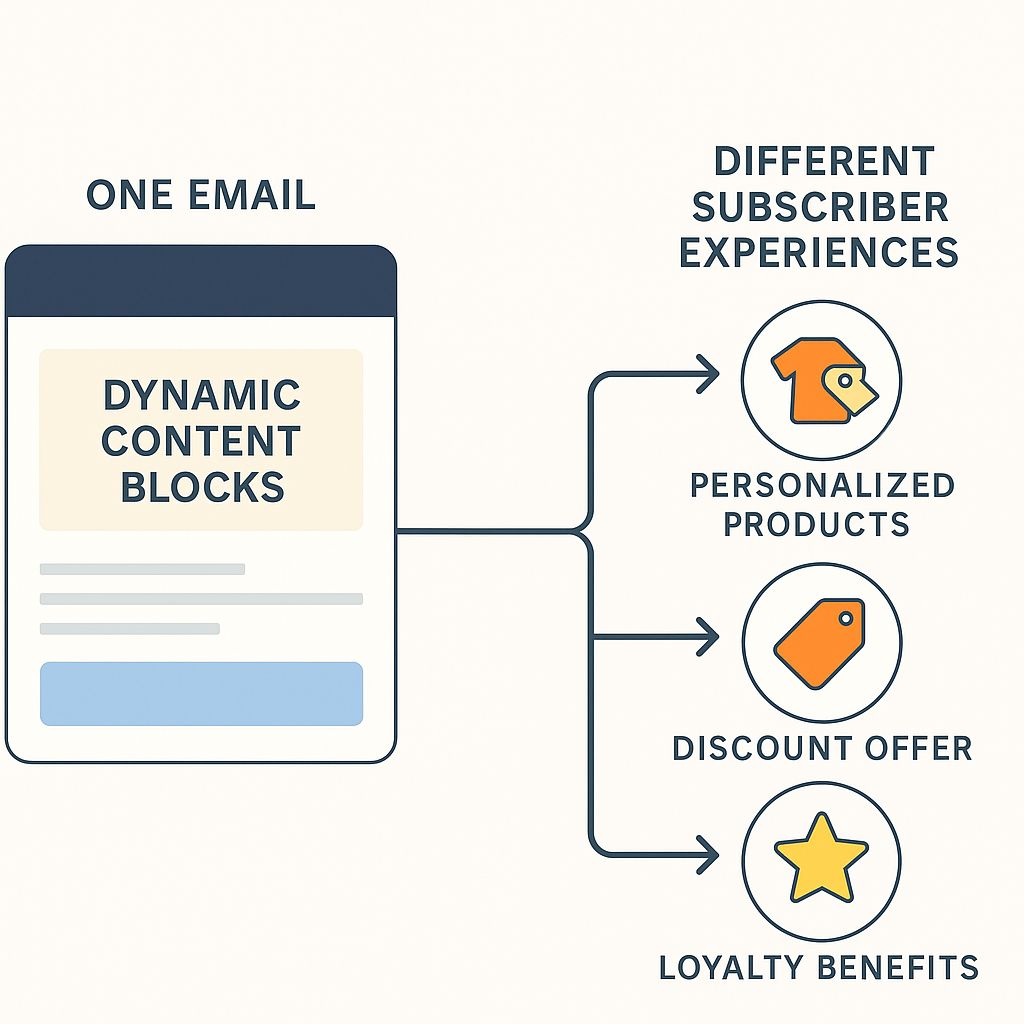
    Instead of sending separate versions of an email to different segments, dynamic content blocks allow you to automatically tailor content inside a single email based on each subscriber’s profile data, behavior, or preferences. The result? More relevant experiences, higher clicks, and stronger customer engagement.


    What Are Dynamic Content Blocks in Klaviyo?

    Dynamic content blocks are modular sections within an email that change depending on who receives it. Klaviyo uses customer data — such as purchase history, location, gender, loyalty status, or engagement behavior — to decide what content displays to each subscriber.

    For example, two people may receive the same campaign email, but see entirely different product recommendations, offers, or CTAs based on their unique profiles.


    Why Dynamic Content Blocks Matter

    The beauty of dynamic content blocks is efficiency: instead of building multiple emails for different segments, you create one email with multiple tailored experiences. This not only saves time but ensures every recipient sees messaging that resonates.

    Key benefits include:

    • Increased CR – Personalized recommendations and targeted offers encourage more clicks.
    • Higher engagement – Customers are more likely to interact when the content feels relevant to them.
    • Stronger loyalty – Delivering value through personalization shows customers you understand them.
    • Improved efficiency – Build one master email instead of juggling multiple versions.
    • Reduce unsubscribes: When subscribers consistently receive content that’s tailored to their interests, they’re far less likely to disengage or hit “unsubscribe.”
    • Boost revenue: Personalized product recommendations and conditional discounts not only capture attention but also drive higher conversions, leading to stronger sales and long-term revenue growth.

    Diagram showing one email with "Dynamic Content Blocks" branching into three subscriber experiences: Personalized Products, Discount Offer, and Loyalty Benefits.

    Ways to Use Dynamic Content Blocks to Drive Engagement

    Here are some of the most effective applications in Klaviyo:

    1. Personalized Product Recommendations

    Use dynamic blocks to show customers content related to their previous purchases or to cross-sell complementary items. For example, if someone recently bought skincare, display complementary items like serums or moisturizers.

    2. Conditional Discounts

    Reward VIPs or first-time buyers with exclusive offers. For instance, “Free Gift with Purchase” may show for new subscribers, while returning customers see “10% Off as a Thank You.”

    3. Location-Specific Content

    Use dynamic blocks to display local store events, region-specific shipping updates, or seasonal promotions depending on the subscriber’s location.

    4. Loyalty Benefits

    Highlight reward points, referral bonuses, or member-only perks for loyalty program members — while hiding these blocks from non-members.

    5. Hide Irrelevant Content After Purchase

    If someone has already purchased a product, hide any blocks that promote it, and replace them with accessories, upgrades, or cross-sell opportunities.

    6. Optimized Sign-Up Forms

    Present a tap-to-text option for SMS on mobile devices and a phone number input on desktop within the same sign-up form. 

Each of these tactics ensures customers only see what’s most relevant to them, creating a valuable and tailored experience.

    7. Abandoned Cart Recovery

    Show the specific products a customer left in their cart to encourage them to return and complete their purchase.


    Setting Up Dynamic Content Blocks in Klaviyo

    Let’s say you’re an e-commerce brand selling coffee products. You want to send a promotional email but make it more engaging with personalized blocks.

    Step 1: Create Your Base Email

    • Start with a standard campaign in Klaviyo (e.g., “Shop Our Coffee Collection”).

    Step 2: Add a Dynamic Block

    • Insert a product block into your email template.
    • Select “Show/Hide Logic” in the block settings.

    Step 3: Define Display Conditions

    • For customers tagged as espresso lovers, show new espresso blends.
    • For filter coffee fans, show ground coffee bags.
    • For VIP loyalty members, display a 20% off block.

    Step 4: Add Fallback Content

    • Always include default content for subscribers who don’t meet any condition, ensuring no blank sections.

    Step 5: Test Before Sending

    • Preview the email as different customer profiles to confirm the correct blocks appear.

    Now, instead of sending three different emails, you’ve created one dynamic email that adapts automatically to each subscriber.


    The Bottom Line

    Dynamic content blocks in Klaviyo transform email marketing from generic blasts into personalized conversations. By tailoring messages with product recommendations, conditional offers, location-specific content, and loyalty benefits, you deliver value that resonates deeply with each subscriber.

    The result? Higher click-through rates, stronger engagement, and more revenue — without the burden of building multiple campaigns.

    In email marketing today, personalization isn’t just a nice-to-have — it’s the difference between being ignored and being irresistible. Dynamic content blocks make that personalization scalable, efficient, and impactful.

  • How to Build Stronger Customer Relationships with an Omnichannel Strategy Using Email, SMS, and Push Notifications

    How to Build Stronger Customer Relationships with an Omnichannel Strategy Using Email, SMS, and Push Notifications

    Today’s consumers don’t stick to just one channel—they move seamlessly between email, text, and apps on their phones. For brands, this means that building relationships with customers requires more than just blasting out campaigns. It calls for a cohesive omnichannel strategy that leverages email, SMS, and push notifications in complementary ways.

    With over 72% of e-commerce sales now taking place on mobile devices, the opportunity to meet your customers where they already are has never been greater. Let’s explore how each channel plays a role in nurturing relationships, what types of messages perform best, and how to orchestrate them into a unified customer experience.


    Why Omnichannel Matters

    A single channel approach limits your reach. Some customers prefer checking emails in the morning, while others respond instantly to SMS or engage with app notifications on the go. By using a coordinated omnichannel strategy, you can:

    • Reach customers at the right moment, on their preferred device.
    • Reinforce your message across multiple touchpoints.
    • Build stronger connections by offering value, not just promotions.
    • Drive higher engagement, conversions, and loyalty.
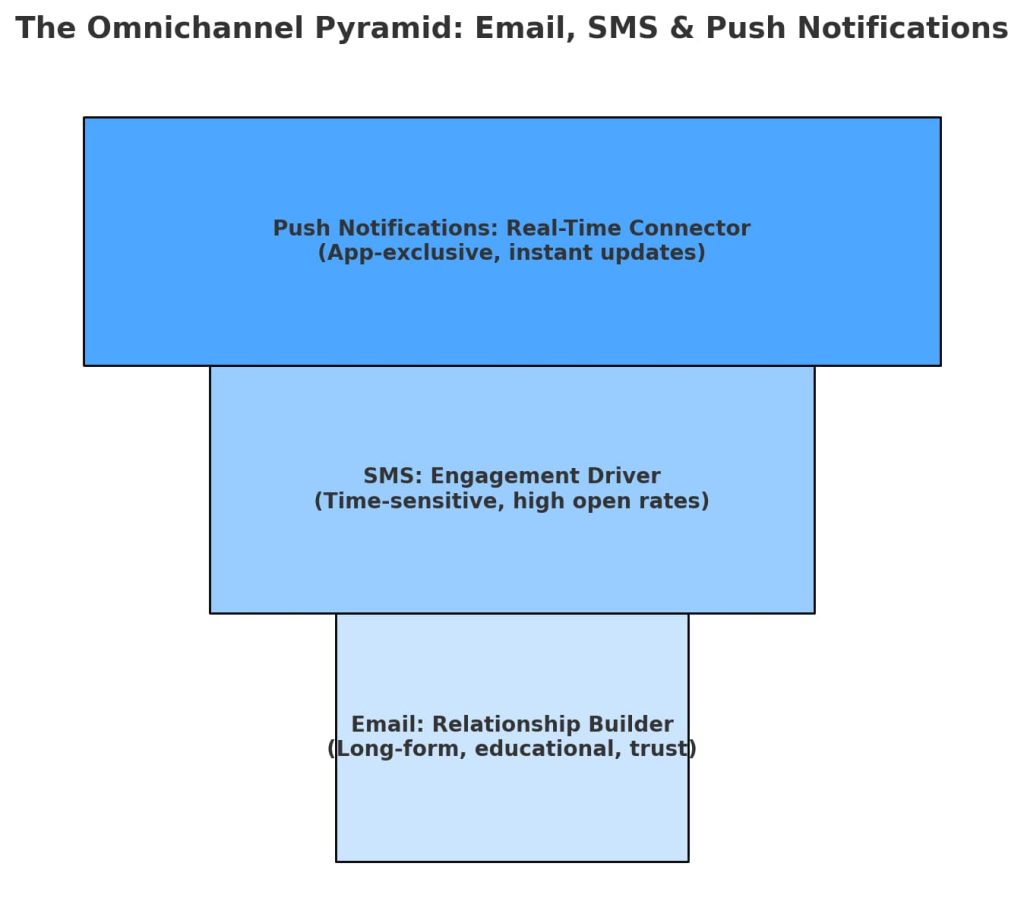
    A pyramid diagram divides communication tools into three layers. Top: Push Notifications as real-time connectors. Middle: SMS as engagement drivers. Bottom: Email as relationship builders.

    Email: The Relationship Builder

    Email remains the cornerstone of digital customer relationships. It’s a channel where long-form storytelling, rich visuals, and detailed content thrive. It’s also cost-effective and ROI-driven.

    Best types of email messages:

    • Welcome Series: Introduce your brand story, mission, and key products.
    • Newsletters: Share educational content, tutorials, or styling tips.
    • Exclusive Offers: Reward subscribers with early access or VIP promotions.
    • Transactional Emails: Order confirmations, shipping updates, and receipts.

    Email excels at building trust and delivering value over time—it’s the backbone of retention marketing.


    SMS: The Engagement Driver

    SMS cuts through the noise with immediacy. Open rates hover near 98%, making it one of the most powerful channels for time-sensitive or high-priority messages. While SMS is often seen as sales-driven, it can also deepen relationships when used strategically.

    Best types of SMS messages:

    • Flash Sales & Limited-Time Offers: Perfect for urgency-driven promotions.
    • Abandoned Cart Reminders: Give a gentle nudge to complete checkout.
    • Exclusive VIP Alerts: Reward loyalty members with unique discounts.
    • Replenishment Reminders: Prompt repeat purchases for consumable products.

    The key is to keep SMS short, personal, and reserved for moments where attention is critical.


    Push Notifications: The Real-Time Connector

    Push notifications are underutilized but incredibly powerful—especially since they reach customers directly on their mobile devices. They’re particularly effective for time-sensitive reminders and promotions tied to your brand’s mobile app.

    ✅ Advantages of Push Notifications

    📱 High visibility – Delivered directly to lock screens, making them harder to miss.

    🚫 Bypass filters – Unlike email, push notifications can’t end up in spam folders.

    Timely & relevant – Pair with in-app activity for perfectly timed, personalized messages.

    🎯 Behavior-based targeting – Trigger notifications based on user preferences and actions.

    ⚖️ Fewer restrictions – Less stringent legal barriers compared to SMS, especially useful in regulated industries.

    📈 Boost engagement – Proven to increase app opens, retention, and user activity.

    Best types of push notifications:

    • App-Exclusive Discounts: Incentivize app engagement with special deals.
    • Product Drop Alerts: Notify customers instantly when a new collection launches.
    • Shipping Updates: Real-time delivery notifications keep customers engaged.
    • Personalized Reminders: Re-engage users who haven’t opened the app recently.

    Push works best when it complements email and SMS, delivering immediacy without overwhelming your audience.


    Orchestrating the Three Channels Together

    The power of omnichannel lies in orchestration. Rather than using each channel in isolation, coordinate them to work in harmony:

    • Email + SMS: Send a detailed product launch email, then follow up with a short, time-sensitive SMS reminder.
    • Email + Push: Share a content-rich email (e.g., styling guide) and reinforce it with a push notification that drives app engagement.
    • SMS + Push: Alert customers about a flash sale with SMS, then send app users a push notification for exclusive early access.

    By combining channels, you meet customers across their journey—whether they’re browsing their inbox, checking texts, or engaging with your app.

    From Social Media to Five Stars: Roni’s Omnichannel Success Story

    Meet Taylor, a new customer discovering Roni for the first time. Taylor’s journey began on social media, where engaging content sparked curiosity and led them to Roni’s website. Once there, Taylor signed up for both the email newsletter and SMS list—giving Roni permission to connect across multiple touchpoints.

    Shortly after, Taylor received a friendly SMS inviting them to download Roni’s mobile app, which opened the door for even richer engagement. Later, a push notification announced Roni’s seasonal fall sale, prompting Taylor to browse products in the app. When Taylor left an item in their cart, an abandoned cart flow—delivered via email—nudged them to complete the purchase, which they did seamlessly.

    The experience continued beyond checkout. Taylor received an SMS with order tracking updates and a warm thank-you email for their purchase. Once the products arrived, Roni sent a timely push notification through the app, asking Taylor to share their feedback. Delighted with both the products and the smooth experience, Taylor left a glowing five-star review.

    This journey perfectly illustrates the power of an omnichannel strategy. By orchestrating email, SMS, and push notifications, Roni was able to guide Taylor at every step—building trust, encouraging action, and creating a seamless, engaging customer experience that turns first-time buyers into loyal fans.

    ✅ Omnichannel Campaign Playbook: Email + SMS + Push

    Step 1: Email (Launch Announcement)

    📅 Timing: Send Day 1 (morning or early afternoon)
    📩 Goal: Build awareness and excitement.
    🔑 Checklist:

    • Share the big story: new product launch, seasonal sale, or special event.
    • Use visuals, detailed descriptions, and your brand voice.
    • Include multiple CTAs (e.g., Shop Now, Learn More, Explore Collection).
    • Segment based on interests or purchase history for added personalization.

    Step 2: SMS (Reminder & Urgency)

    📅 Timing: Send Day 2 (24–48 hours after email, or midway through promo).
    📲 Goal: Drive immediate action with urgency.
    🔑 Checklist:

    • Keep it short and direct: “Don’t miss out—sale ends soon!”
    • Add urgency (“Only 12 hours left”) or exclusivity (“VIP early access”).
    • Include a short, mobile-friendly link.
    • Use sparingly—reserve for high-value or time-sensitive campaigns.

    Step 3: Push Notification (Final Nudge)

    📅 Timing: Send Day 3 (final day of campaign or a few hours before deadline).
    🔔 Goal: Capture last-minute conversions.
    🔑 Checklist:

    • Send real-time updates like “Last chance—deal ends at midnight!”.
    • Pair with app-exclusive discounts or perks.
    • Personalize with user behavior: “Still thinking about your cart? Complete your order now.”
    • Avoid overloading—limit to 1–2 pushes per campaign.

    Best Practices for All Three Channels

    • 🔄 Stay consistent: Align tone, branding, and offers across channels.
    • 🧩 Segment smartly: Target based on preferences, purchase history, and engagement.
    • 📊 Measure & optimize: Track open, click, and conversion rates across all channels.
    • 💡 Respect frequency: Don’t overwhelm—space out touchpoints strategically.

    👉 Pro Tip: Think of your channels as a relay team: Email sets the stage, SMS drives urgency, and Push delivers the final win.


    Best Practices for Success

    • Respect Frequency: Avoid overwhelming customers; balance touchpoints across channels.
    • Segment Smartly: Use behavior and preferences to target messages effectively.
    • Stay Consistent: Keep your tone and visuals aligned across email, SMS, and push.
    • Prioritize Value: Don’t just push promotions—share helpful, relevant content.

    Final Takeaway

    Strong customer relationships aren’t built by chance—they’re nurtured through consistent, relevant, and coordinated communication. By combining email for depth, SMS for immediacy, and push for real-time engagement, brands can create a seamless omnichannel strategy that not only drives sales but also fosters loyalty and trust.

    In an era where mobile dominates, the brands that master this mix will be the ones that win the long game of customer retention.