Today’s consumers don’t stick to just one channel—they move seamlessly between email, text, and apps on their phones. For brands, this means that building relationships with customers requires more than just blasting out campaigns. It calls for a cohesive omnichannel strategy that leverages email, SMS, and push notifications in complementary ways.
With over 72% of e-commerce sales now taking place on mobile devices, the opportunity to meet your customers where they already are has never been greater. Let’s explore how each channel plays a role in nurturing relationships, what types of messages perform best, and how to orchestrate them into a unified customer experience.
Why Omnichannel Matters
A single channel approach limits your reach. Some customers prefer checking emails in the morning, while others respond instantly to SMS or engage with app notifications on the go. By using a coordinated omnichannel strategy, you can:
- Reach customers at the right moment, on their preferred device.
- Reinforce your message across multiple touchpoints.
- Build stronger connections by offering value, not just promotions.
- Drive higher engagement, conversions, and loyalty.
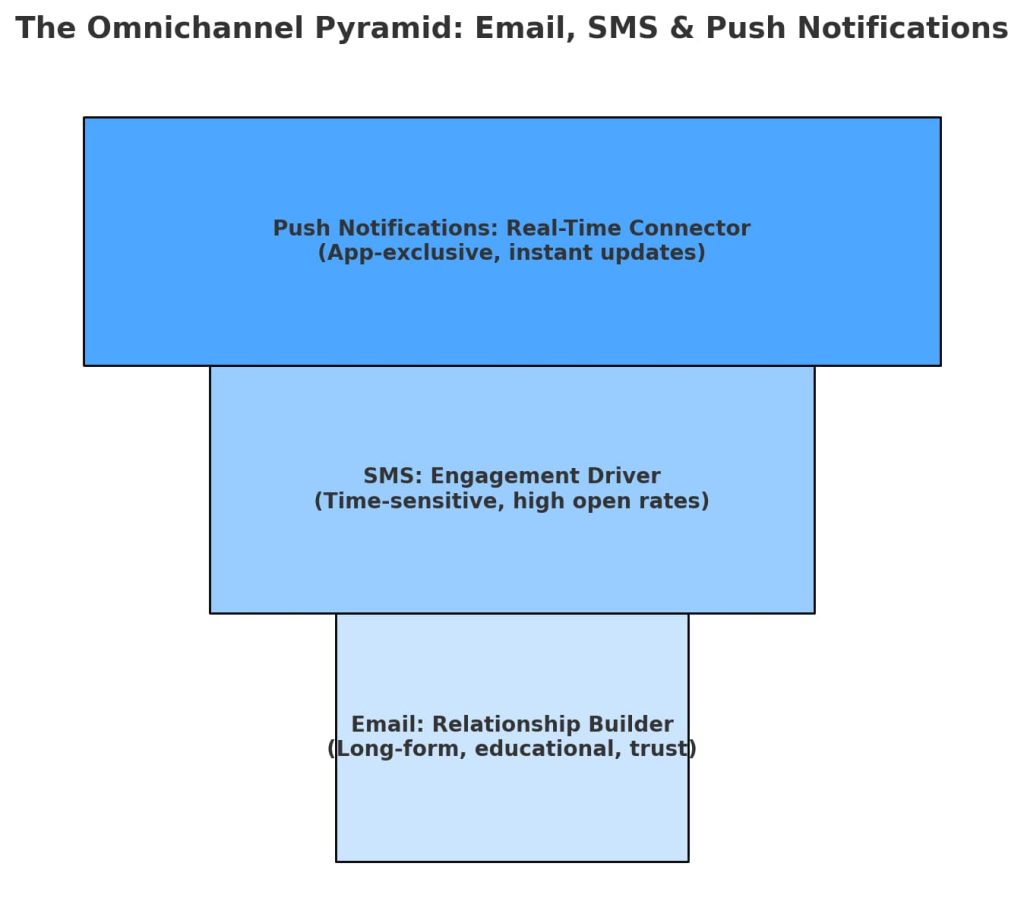
Email: The Relationship Builder
Email remains the cornerstone of digital customer relationships. It’s a channel where long-form storytelling, rich visuals, and detailed content thrive. It’s also cost-effective and ROI-driven.
Best types of email messages:
- Welcome Series: Introduce your brand story, mission, and key products.
- Newsletters: Share educational content, tutorials, or styling tips.
- Exclusive Offers: Reward subscribers with early access or VIP promotions.
- Transactional Emails: Order confirmations, shipping updates, and receipts.
Email excels at building trust and delivering value over time—it’s the backbone of retention marketing.
SMS: The Engagement Driver
SMS cuts through the noise with immediacy. Open rates hover near 98%, making it one of the most powerful channels for time-sensitive or high-priority messages. While SMS is often seen as sales-driven, it can also deepen relationships when used strategically.
Best types of SMS messages:
- Flash Sales & Limited-Time Offers: Perfect for urgency-driven promotions.
- Abandoned Cart Reminders: Give a gentle nudge to complete checkout.
- Exclusive VIP Alerts: Reward loyalty members with unique discounts.
- Replenishment Reminders: Prompt repeat purchases for consumable products.
The key is to keep SMS short, personal, and reserved for moments where attention is critical.
Push Notifications: The Real-Time Connector
Push notifications are underutilized but incredibly powerful—especially since they reach customers directly on their mobile devices. They’re particularly effective for time-sensitive reminders and promotions tied to your brand’s mobile app.
✅ Advantages of Push Notifications
📱 High visibility – Delivered directly to lock screens, making them harder to miss.
🚫 Bypass filters – Unlike email, push notifications can’t end up in spam folders.
⏱ Timely & relevant – Pair with in-app activity for perfectly timed, personalized messages.
🎯 Behavior-based targeting – Trigger notifications based on user preferences and actions.
⚖️ Fewer restrictions – Less stringent legal barriers compared to SMS, especially useful in regulated industries.
📈 Boost engagement – Proven to increase app opens, retention, and user activity.
Best types of push notifications:
- App-Exclusive Discounts: Incentivize app engagement with special deals.
- Product Drop Alerts: Notify customers instantly when a new collection launches.
- Shipping Updates: Real-time delivery notifications keep customers engaged.
- Personalized Reminders: Re-engage users who haven’t opened the app recently.
Push works best when it complements email and SMS, delivering immediacy without overwhelming your audience.
Orchestrating the Three Channels Together
The power of omnichannel lies in orchestration. Rather than using each channel in isolation, coordinate them to work in harmony:
- Email + SMS: Send a detailed product launch email, then follow up with a short, time-sensitive SMS reminder.
- Email + Push: Share a content-rich email (e.g., styling guide) and reinforce it with a push notification that drives app engagement.
- SMS + Push: Alert customers about a flash sale with SMS, then send app users a push notification for exclusive early access.
By combining channels, you meet customers across their journey—whether they’re browsing their inbox, checking texts, or engaging with your app.
From Social Media to Five Stars: Roni’s Omnichannel Success Story
Meet Taylor, a new customer discovering Roni for the first time. Taylor’s journey began on social media, where engaging content sparked curiosity and led them to Roni’s website. Once there, Taylor signed up for both the email newsletter and SMS list—giving Roni permission to connect across multiple touchpoints.
Shortly after, Taylor received a friendly SMS inviting them to download Roni’s mobile app, which opened the door for even richer engagement. Later, a push notification announced Roni’s seasonal fall sale, prompting Taylor to browse products in the app. When Taylor left an item in their cart, an abandoned cart flow—delivered via email—nudged them to complete the purchase, which they did seamlessly.
The experience continued beyond checkout. Taylor received an SMS with order tracking updates and a warm thank-you email for their purchase. Once the products arrived, Roni sent a timely push notification through the app, asking Taylor to share their feedback. Delighted with both the products and the smooth experience, Taylor left a glowing five-star review.
This journey perfectly illustrates the power of an omnichannel strategy. By orchestrating email, SMS, and push notifications, Roni was able to guide Taylor at every step—building trust, encouraging action, and creating a seamless, engaging customer experience that turns first-time buyers into loyal fans.
✅ Omnichannel Campaign Playbook: Email + SMS + Push
Step 1: Email (Launch Announcement)
📅 Timing: Send Day 1 (morning or early afternoon)
📩 Goal: Build awareness and excitement.
🔑 Checklist:
- Share the big story: new product launch, seasonal sale, or special event.
- Use visuals, detailed descriptions, and your brand voice.
- Include multiple CTAs (e.g., Shop Now, Learn More, Explore Collection).
- Segment based on interests or purchase history for added personalization.
Step 2: SMS (Reminder & Urgency)
📅 Timing: Send Day 2 (24–48 hours after email, or midway through promo).
📲 Goal: Drive immediate action with urgency.
🔑 Checklist:
- Keep it short and direct: “Don’t miss out—sale ends soon!”
- Add urgency (“Only 12 hours left”) or exclusivity (“VIP early access”).
- Include a short, mobile-friendly link.
- Use sparingly—reserve for high-value or time-sensitive campaigns.
Step 3: Push Notification (Final Nudge)
📅 Timing: Send Day 3 (final day of campaign or a few hours before deadline).
🔔 Goal: Capture last-minute conversions.
🔑 Checklist:
- Send real-time updates like “Last chance—deal ends at midnight!”.
- Pair with app-exclusive discounts or perks.
- Personalize with user behavior: “Still thinking about your cart? Complete your order now.”
- Avoid overloading—limit to 1–2 pushes per campaign.
Best Practices for All Three Channels
- 🔄 Stay consistent: Align tone, branding, and offers across channels.
- 🧩 Segment smartly: Target based on preferences, purchase history, and engagement.
- 📊 Measure & optimize: Track open, click, and conversion rates across all channels.
- 💡 Respect frequency: Don’t overwhelm—space out touchpoints strategically.
👉 Pro Tip: Think of your channels as a relay team: Email sets the stage, SMS drives urgency, and Push delivers the final win.
Best Practices for Success
- Respect Frequency: Avoid overwhelming customers; balance touchpoints across channels.
- Segment Smartly: Use behavior and preferences to target messages effectively.
- Stay Consistent: Keep your tone and visuals aligned across email, SMS, and push.
- Prioritize Value: Don’t just push promotions—share helpful, relevant content.
Final Takeaway
Strong customer relationships aren’t built by chance—they’re nurtured through consistent, relevant, and coordinated communication. By combining email for depth, SMS for immediacy, and push for real-time engagement, brands can create a seamless omnichannel strategy that not only drives sales but also fosters loyalty and trust.
In an era where mobile dominates, the brands that master this mix will be the ones that win the long game of customer retention.
Leave a Reply