
Segmentation is the backbone of high-performing email marketing. It simply means dividing your subscribers into groups based on the interests, characteristics or behaviors you can track—such as how they interact with your emails or website—and then sending each group tailored offers and communications that match their interests.
When you first start with email marketing, every subscriber usually gets tossed into one big bucket. Everyone receives the same message—and in the beginning, that’s fine. But as your list grows, you’ll start to notice something important: not all subscribers are the same. Some are brand-new and just getting to know you, while others are further down the funnel and closer to buying. Some want quick tips and advice, while others are more interested in learning your brand story.
That’s where segmentation comes in.
Instead of blasting every email to your entire list, segmentation allows you to send tailored, relevant messages to specific individuals based on shared characteristics, activity or behaviors. Segments help your emails become more targeted, personalized, and relevant. By tailoring your offers to match each group’s specific needs and interests, you send smarter emails and significantly increase the chances of engagement, conversions, and ultimately, more sales.
Create customer persona segments to group your customers by various characteristics, such as:
- Their interests
- How much they spend
- How frequently they purchase
Then, send personalized content based on these personas. For example, if you sell pet products, you may send a cat food product launch campaign to a segment of cat owners.
The Benefits of Segmentation in Email Marketing
Segmentation is one of the most powerful strategies in email marketing. It allows you to talk to the right people at the right time. In fact, according to Klaviyo’s yearly benchmark report, highly segmented emails result in:
- Lower unsubscribe rates (unsegmented campaigns lead to 2x the amount of unsubscribes in comparison).
- 2x the average open and click rates compared to emails sent to unsegmented lists.
- 3x the revenue per recipient ($0.19 vs. $0.06).
Segmentation goes far beyond just improving campaign performance. It forces you to think strategically about your customers, which creates a foundation for many of your broader business and marketing processes.
By breaking your audience into subsets, you’re not just organizing your email list—you’re gathering valuable business intelligence. You’ll see which groups drive the most revenue, which ones engage the most with your campaigns, and where to focus your marketing resources for maximum impact.
Here are the key benefits of segmentation:
1. Increased Engagement
When you send messages that align with a customer’s interests or behavior, they’re far more likely to open, click, and respond. Segmentation ensures your campaigns are highly relevant, which naturally drives higher engagement rates compared to generic, one-size-fits-all emails.
2. Higher Sales and Revenue
Relevance drives conversions. By tailoring your offers to specific groups—such as past purchasers, repeat buyers, or customers who browsed a particular category—you’re sending promotions they’re more likely to act on. This targeted approach directly translates into higher sales.
3. Improved Customer Lifetime Value
Segmentation helps you nurture customers at every stage of their journey. From personalized upsell campaigns to win-back flows for inactive customers, segmentation allows you to keep customers engaged longer. The result: a measurable increase in lifetime customer value (LTV).
4. Lower Unsubscribe Rates
When subscribers consistently receive emails that matter to them, they’re far less likely to hit “unsubscribe.” Segmentation minimizes list fatigue, extends the lifespan of your subscriber base, and saves you money by keeping your audience engaged rather than forcing you to constantly chase new leads.
5. Smarter Resource Allocation
By analyzing segmented data, you can see which groups of customers are most valuable. This intelligence allows you to prioritize your marketing budget and energy where it will deliver the highest return, instead of spreading your efforts too thin.
6. Automation Potential
One of the most powerful aspects of segmentation is how well it pairs with automation. Modern platforms like Klaviyo let you design automated flows that target specific users based on characteristics (such as age, location, or gender) or event triggers (such as browsing certain products, purchasing a specific item, or reaching a VIP spend threshold). These automated, behavior-driven campaigns run in the background, saving you time while continually delivering relevant, high-performing emails.
Essential Email Segments
Effective segmentation is the foundation of modern email marketing. By grouping customers based on their behaviors, preferences, and lifecycle stage, brands can send messages that feel personal, timely, and relevant — the key ingredients for driving engagement, loyalty, and sales.
Below are the 13 most impactful customer segments every brand should prioritize, along with clear goals and actionable steps for each.
1. New Subscribers (Welcome Flow)
Goal: Encourage prospects to make their first purchase.
The welcome series is your chance to make a lasting first impression. New subscribers are most engaged right after signing up, so capitalize on that moment.
Best practices:
- Automate a welcome series: Send 3–8 emails spaced out over the first 1–2 weeks. Gradually build a connection by sharing your brand story, value proposition, and bestsellers.
- Act fast: Deliver the first message immediately after signup.
- Offer an incentive: A welcome discount is often the nudge first-time buyers need.
- Gather preferences: Include options to personalize future communications — e.g., “Tell us what you’re most interested in.”
Done right, your welcome series sets the tone for the relationship and primes subscribers for their first purchase.
2. Cart Abandoners (Cart/Checkout Abandonment Flow)
Goal: Recover potentially lost sales.
Cart abandonment is one of the biggest lost revenue opportunities in e-commerce — but also one of the easiest to fix.
Best practices:
- Segment checkout abandoners: Identify users who added products to their cart but didn’t complete checkout.
- Use dynamic content: Display images of the exact items left behind.
- Send reminders quickly: The first reminder should go out within 24 hours.
- Add urgency or incentives: For high-value carts, consider offering limited-time discounts.
- Make it seamless: Use clear CTAs like “Return to Your Cart” to reduce friction.
3. Recent Buyers (Post-Purchase Flow)
Goal: Increase customer lifetime value through upsells and cross-sells.
The sale isn’t the end of the journey — it’s the beginning of loyalty. Post-purchase flows are critical for nurturing customers beyond their first order.
Best practices:
- Segment by purchase history: Recommend products that complement their recent purchase.
- Avoid generic bestsellers: Recommendations should feel thoughtful and relevant.
- Educate and empower: Create content series that help them get the most out of what they bought.
- Position recommendations as helpful, not pushy: “Complete your collection” or “Get more from your purchase” works better than hard selling.
This flow not only drives repeat purchases but also builds trust by showing customers you’re invested in their success with your products.
4. Inactive Customers (Win-Back Flow)
Goal: Reignite interest among customers who haven’t purchased in 60–120 days.
Customer churn happens, but with smart win-back campaigns, you can re-spark connections.
Best practices:
- Leverage purchase history: Recommend products that naturally follow from past buys.
- Show what’s new: Highlight updates since their last engagement.
- Personalize, don’t generalize: Avoid random promotions; make suggestions feel curated.
- Time it right: For consumables, use average usage timelines to time replenishment emails.
A personalized reminder can turn “forgotten” customers into loyal repeat buyers.
5. Browsing Abandoners (Browse Abandonment Flow)
Goal: Re-engage customers based on browsing behavior.
Not every shopper who shows intent adds items to their cart. Browse abandonment flows let you capitalize on interest before it fades.
Best practices:
- Track browsing behavior: Identify products or categories customers explored.
- Segment by product viewed: Send emails showcasing those specific items.
- Address barriers: Answer objections like shipping costs or product details.
- Add urgency: Use messaging like “Only a few left” to nudge conversions.
OluKai’s personalized product reminder email leverages browsing behavior to re-engage shoppers and encourage them to return to the store. The headline — “One Step Away From Aloha” — delivers a light, friendly nudge to users who viewed a product but didn’t add it to their cart or complete a purchase.
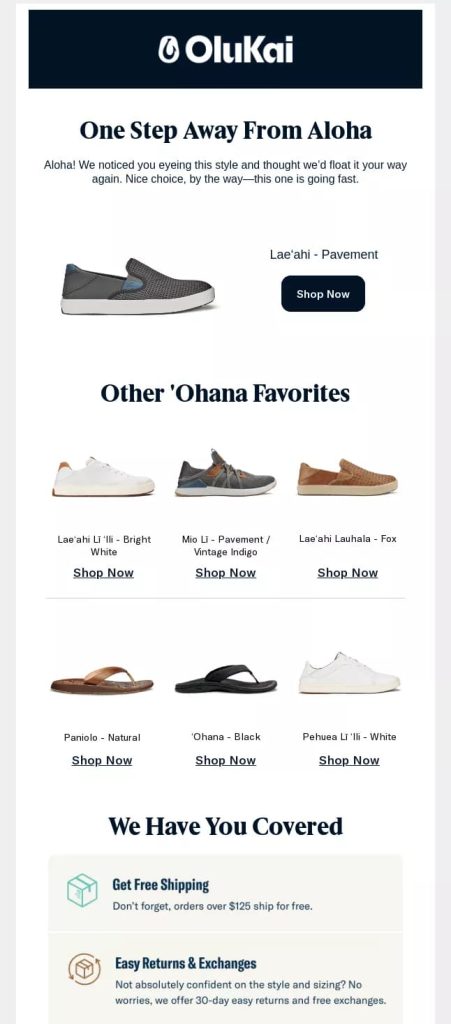
The featured shoe takes center stage, paired with a message that conveys subtle urgency (“This one is going fast”). Below, a curated row of related styles, labeled “Other ‘Ohana Favorites,” provides appealing alternatives to increase engagement and conversion. Reassurances such as free shipping and easy returns help overcome hesitation and make purchase decisions easier.
This email is a textbook example of behavior-based segmentation, keeping products top-of-mind while offering both alternatives and support to maximize the likelihood of conversion.
6. Inactive Subscribers (Sunset Flow)
Goal: Win back dormant subscribers while maintaining deliverability.
Not all subscribers stay engaged forever, but you can reawaken many before suppressing them.
Best practices:
- Define inactivity: Typically no purchase or engagement in 90–180 days.
- Vary approaches: Test casual check-ins, special offers, or curiosity-driven subject lines.
- Know when to let go: Suppress persistently unresponsive subscribers to protect email deliverability.
- Personalize by history: Tailor re-engagement emails based on past interactions.
7. VIP Customers (VIP Flow)
Goal: Maximize revenue from your most valuable customers and strengthen relationships by providing exclusive access to premium products or limited editions.
High-value customers aren’t motivated by discounts — they respond to exclusivity, quality, and unique experiences. Focus on what makes your offering special: limited availability, superior craftsmanship, premium features, or elevated service. By emphasizing value over price, you create a sense of privilege that resonates with your most loyal and valuable shoppers.
Best practices:
- Identify top customers: Use spending, frequency, and engagement data.
- Acknowledge their status: Call it out explicitly in subject lines and content.
- Offer exclusive perks: Early access, special events, limited editions, or premium service.
- Focus on appreciation: Make them feel celebrated, not exploited.
Example: Stokke’s premium product email is designed to engage high-value, VIP customers by featuring the exclusive Limited Edition Xplory® X Gold stroller. This campaign strategically targets top-tier shoppers who are most likely to appreciate and invest in luxury offerings.
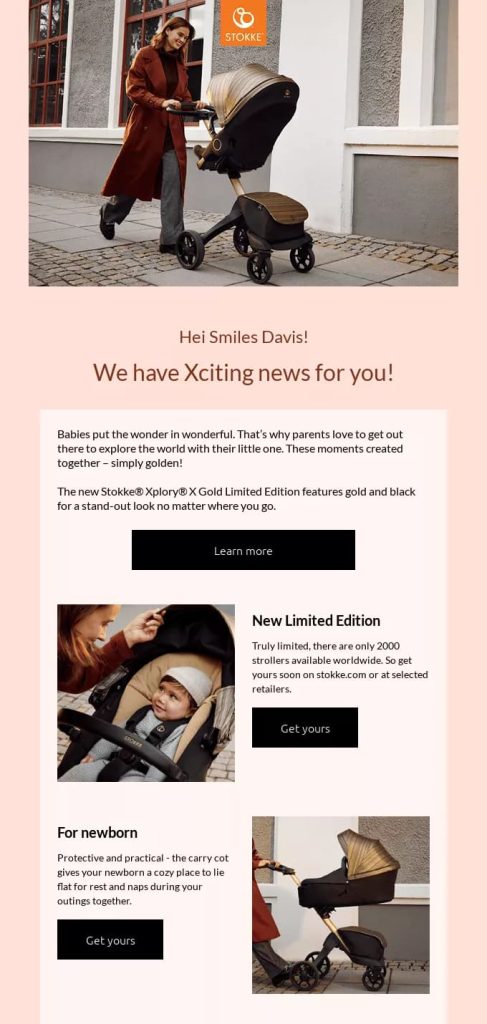
The headline — “We have Xciting news for you!” — sparks curiosity, while personalized touches like the recipient’s name enhance the VIP experience. With only 2,000 units available worldwide, the stroller’s exclusivity is emphasized, positioning it as a luxury must-have.
Elegant visuals, gold accents, and lifestyle imagery reinforce the product’s premium status, while clear CTAs — “Learn more” and “Get yours” — make it effortless for engaged customers to act, appealing to their desire for quality, status, and exclusivity.
8. Special Events (Birthday Flow)
Goal: Build emotional connections through celebration.
Few things feel more personal than a birthday message — especially one that comes with a thoughtful perk.
Best practices:
- Collect dates upfront: Gather birthdays during signup or in preference centers.
- Send at the right time: A few days before the birthday ensures they can use any special offer.
- Keep it personal: Focus on well-wishes first, promotions second.
- Offer a gift: A birthday-exclusive discount or freebie creates delight.
- Measure impact: Track redemption rates to refine your approach.
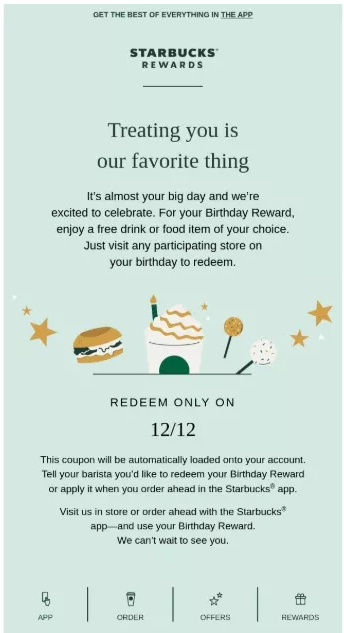
This birthday email from Starbucks delivers a warm, celebratory experience for the customer. The friendly headline — “Treating you is our favorite thing” — immediately conveys a sense of personal attention, while offering a free drink or food item to redeem on the recipient’s special day.
The design is clean and visually appealing, featuring illustrations of treats that reinforce the celebratory mood without overwhelming the message. The customer’s birthday is prominently highlighted, creating a timely and personal call-to-action that encourages immediate engagement.
9. Seasonal & Holiday (Holiday Flow)
Goal: Align promotions with seasons, weather, and regional holidays.
Seasonality is a powerful driver of purchases, but success depends on smart timing and localization.
Best practices:
- Segment by location: Different regions have different holidays and climates.
- Use historical data: Learn from previous seasonal buying trends.
- Plan ahead: Start early enough to catch planners, but maintain urgency with limited-time offers.
- Localize messaging: Adapt language, currency, and cultural references for maximum relevance.
10. Location-Based Promotions
Goal: Deliver hyper-relevant campaigns tied to geography.
Local context makes messages feel more personal and actionable.
Best practices:
- Leverage location data: Gather from signup, purchase, or browsing.
- Highlight local relevance: Promote nearby store events, shipping deadlines, or local trends.
- Customize content: Reflect regional nuances in messaging and product suggestions.
- Think macro and micro: Tailor both by country/region and local community events.
11. Engaged Customers
Goal: Generate excitement and loyalty by offering pre-sale access.
Highly engaged customers are prime advocates — reward them with exclusivity.
Best practices:
- Identify engaged audiences: Frequent openers, clickers, or repeat buyers.
- Create exclusive previews: Send private links or first access to new products.
- Use personal language: “Reserved for our best customers” builds emotional connection.
- Add urgency: Limited-time or quantity-limited access makes it irresistible.
- Request feedback: Gather insights from your best customers before rolling out widely.
12. One-Time Buyers (Reactivation Flow)
Goal: Convert first-time buyers into repeat customers.
Many customers buy once and never return — but a well-timed reactivation can change that.
Best practices:
- Segment one-time buyers: Focus on those who haven’t returned within your average repeat purchase window.
- Personalize by purchase: Reference their original order to keep it relevant.
- Incentivize return: Offer a discount or free shipping tailored to order value and timing.
- Recommend complements: Suggest items that enhance their first purchase.
Turning one-time buyers into repeat customers is one of the highest-ROI opportunities in email marketing.
13. Window Shoppers (Site Abandonment Flow)
Goal: To engage visitors who signed up to your email list and browsed your website but left without adding anything to their cart.
This flow is essential for ecommerce businesses because it helps recover potential customers who might otherwise disappear for good.
Best practices:
- Segment Your Audience: Don’t treat all site abandoners the same. Segment by behavior: product viewed, category interest, price range, or previous purchase history. Personalization increases relevance and engagement, making it more likely the visitor returns.
- Time Your Emails Strategically: Send the first email within a few hours of the visit while the experience is still fresh. Follow up with 1–2 additional emails spaced over a few days, increasing urgency or offering incentives if appropriate.
- Personalize and Highlight the Product. Include dynamic product recommendations based on the item(s) they viewed. Use persuasive copy and visuals that remind them why they clicked in the first place.
- Test and Optimize Continuously. Use A/B testing on subject lines, send times, copy, and creative. Track metrics like open rates, click-through rates, and conversions. Iterate based on performance to maximize ROI and ensure the flow remains effective over time.
Final Thoughts
Segmentation isn’t about sending more emails — it’s about sending the right emails to the right people at the right time. By building these core segments into your marketing strategy, you create experiences that feel personalized, relevant, and valuable.
The result? Stronger customer relationships, higher lifetime value, and sustainable growth.
Leave a Reply