Author: Andre Hospidales

  • Predictive Analytics in Klaviyo: How to Build Smarter Customer Journeys and Drive More Revenue

    Predictive Analytics in Klaviyo: How to Build Smarter Customer Journeys and Drive More Revenue

    One of the most powerful features inside Klaviyo isn’t just sending emails — it’s using predictive analytics to anticipate customer behavior. By leveraging data science, Klaviyo allows brands to forecast future actions like when a customer will buy again, how much they’re likely to spend, or whether they’re at risk of churning. Done right, predictive analytics transforms your email strategy from reactive to proactive — turning insights into revenue.


    What Are Predictive Analytics?

    Predictive analytics in Klaviyo are machine-learning models built on your historical customer data (orders, engagement, lifetime behavior) to predict what individual subscribers are most likely to do next. Instead of waiting to see what happens, you can anticipate behavior and act strategically.

    Key predictive metrics include:

    • Expected Date of Next Order – Predicts when a customer is likely to buy again.
    • Average Time Between Orders – Shows purchase frequency for better flow timing.
    • Churn Risk Prediction – Identifies customers who are slipping away before they unsubscribe.
    • Predicted Customer Lifetime Value (CLV) – Estimates long-term value to prioritize VIPs.
    • Predicted Average Order Value (AOV) – Forecasts expected basket size for smarter upsells.

    With predictive analytics, when you send emails and SMS messages, Klaviyo can analyze each subscriber’s behavior to determine which channel they’re more likely to engage with. This means that during a promotion or sale, you don’t necessarily have to send both an email and an SMS to every person—you can prioritize the channel they prefer, ensuring your messages reach them in the way they’re most likely to respond.

    For example, if you want to offer a discount code only to customers with a predicted lifetime value above $500, you can set that condition directly in Klaviyo. Or, if you’re emailing someone who recently visited your website, you can dynamically display the exact products they viewed instead of showing generic items.

    In short, anytime you see data in Klaviyo, you can use it to personalize your messaging—making your campaigns more relevant, targeted, and effective.

    How to Leverage Predictive Analytics to Improve the Customer Journey

    1. Personalized Flow Timing

    • Use the Expected Date of Next Order to trigger replenishment reminders right before a customer usually runs out of a product (e.g., skincare, supplements, or coffee).
    • This proactive timing boosts repeat purchase rates without annoying customers too early.

    2. VIP & Loyalty Segmentation

    • Segment customers by Predicted CLV or AOV to create VIP-only campaigns.
    • Offer exclusive perks, early access, or higher-value bundles to customers who represent the most revenue potential.

    3. Churn Prevention Flows

    • Use Churn Risk Prediction to identify at-risk customers.
    • Send them tailored winback emails, surveys to uncover friction, or special offers to reignite engagement before they slip away completely.

    4. Smarter Campaign Targeting

    • If someone is predicted to purchase within the next week, push them product-focused campaigns.
    • If they’re not predicted to order again soon, nurture them with storytelling, content, or educational value to keep them warm.

    5. Strategic Discounting

    • Instead of blanket discounts, target high churn-risk customers with incentives while protecting your margins with loyal or predictable repeat buyers who don’t need discounts to purchase.

    How Predictive Analytics Increase Brand Revenue

    • Higher Repeat Purchases: Timely replenishment campaigns boost purchase frequency.
    • Reduced Churn: Proactive winback strategies save at-risk customers before they leave.
    • Improved Margins: Smarter discounting ensures you’re not over-discounting loyal buyers.
    • Better Customer Experiences: By anticipating needs, you deliver emails that feel hyper-relevant, building long-term loyalty.
    • Optimized Resource Allocation: Focus efforts on high-value customers who drive the majority of revenue.

    Benefits of Using Predictive Analytics in Klaviyo

    1. Personalization at Scale – Every subscriber gets emails aligned with their predicted behaviors.
    2. Efficiency – Save time and resources by targeting based on likelihood, not guesswork.
    3. Proactive Strategy – Don’t wait for engagement to drop; act before it happens.
    4. Increased ROI – By tailoring timing, messaging, and offers, every campaign works harder.
    5. Data-Driven Confidence – Decisions are backed by Klaviyo’s machine learning models, not assumptions.

    The Bottom Line

    Predictive analytics in Klaviyo take the guesswork out of email marketing. By leveraging forecasts like expected next order date, churn risk, and predicted AOV, brands can build smarter customer journeys that increase engagement, drive revenue, and strengthen loyalty.

    The shift is simple but powerful: stop reacting to customer behavior after it happens — start anticipating it.

  • Why Mastering the Customer Journey is Key to Email Marketing Success

    Why Mastering the Customer Journey is Key to Email Marketing Success

    If you’re serious about building a profitable brand, you can’t afford to ignore your customer journey. It’s not enough to simply set up flows, blast out campaigns, and hope everything falls into place. When your messaging isn’t aligned with where someone is in their lifecycle, you risk losing relevance, missing opportunities—and leaving serious revenue on the table.

    The customer journey is the backbone of your email marketing strategy. It determines how you communicate, what you offer, and when you deliver the right message. Brands that deeply understand and align with the customer journey don’t just make sales—they build loyalty, repeat purchases, and long-term growth.

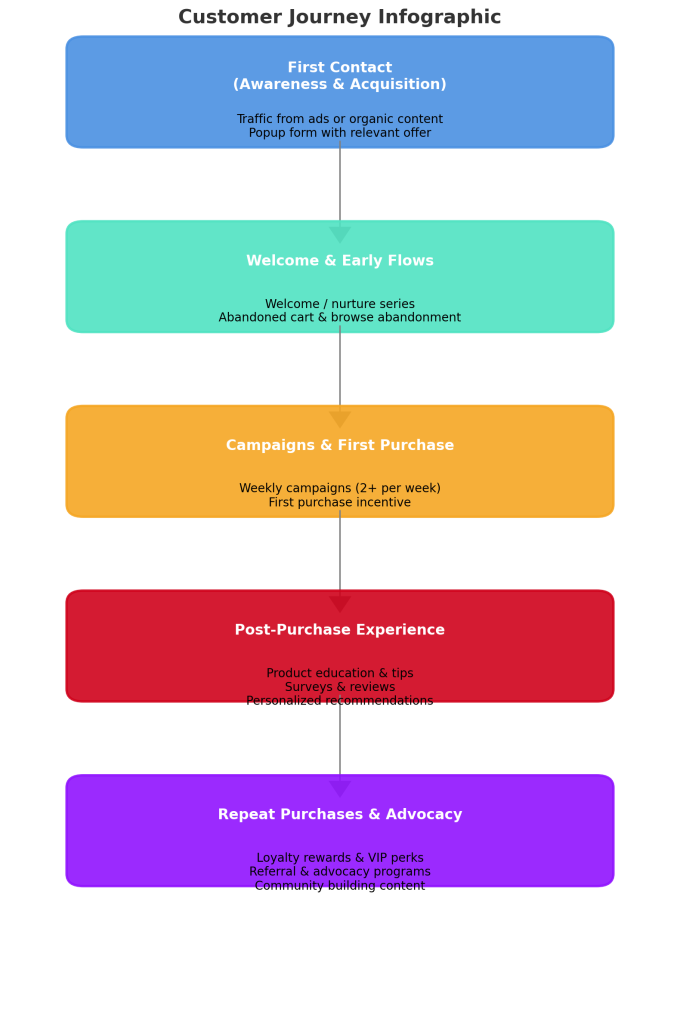
    Customer journey infographic with five color-coded stages: blue for First Contact, green for Welcome, orange for Campaigns, red for Post-Purchase, and purple for Repeat Purchases. Each stage includes brief descriptions of actions and strategies.

    Why the Customer Journey Matters More Than Ever

    Imagine sending a “first-time customer discount” to someone who’s already placed five orders. Not only is that discount useless to them, but it also makes your brand look careless. Misaligned messaging like this erodes trust and can even push loyal customers away.

    When you map and respect the customer journey, everything changes:

    • You speak to subscribers exactly where they are in the lifecycle.
    • You avoid message fatigue by ensuring flows and campaigns work together instead of competing.
    • You maximize conversions at every touchpoint because each email feels timely, relevant, and personal.

    This is where platforms like Klaviyo shine. But tools alone aren’t enough—you need to build with the journey in mind.


    Step 1: First Contact – Awareness & Acquisition

    Every journey begins when someone discovers your brand. Maybe they clicked a Meta or Google ad. Maybe they found you through organic TikTok, Instagram, YouTube or Pinterest content.

    At this stage, the customer knows very little about you. They’re curious—but not yet committed. The first real checkpoint? Your popup form.

    This is where alignment starts. Ask yourself:

    • What does this visitor know about my brand already?
    • What might they care about at this early stage?
    • What are their preferences or pain points?
    • How can my offer or incentive speak directly to that?

    A strong popup doesn’t just capture emails—it connects the dots between the ad/content they saw and the value your brand provides.


    Step 2: Welcome & Early Flows

    Once they sign up, the journey flows into automated emails. This includes your:

    • Welcome series / nurture series (introducing your brand story and value).
    • Abandoned cart flow (if they’ve shown buying intent).
    • Browse abandonment flow (if they were curious but hesitant).

    At this stage, your job is to build trust and establish relevance. Every email should answer one question: Why should I care about this brand, and why should I buy now?


    Step 3: Campaigns & First Purchase

    In parallel, you’re running campaigns (at least twice per week). Combined with your automated flows, this is where your customer is most likely to make their first purchase. At this stage, use features like Smart Sending in Klaviyo to prevent subscribers from being overwhelmed by overlapping campaign and flow messages, ensuring a balanced and positive inbox experience.

    But the journey doesn’t end here—it only shifts. The first purchase is just the beginning of building a customer relationship.


    Step 4: Post-Purchase Experience

    After the first order, the real work begins. This is where brands either nurture loyalty—or lose momentum. What are we going to be communcating to them to ensure that they have the best experience with our product and our brand, that they want to come back and buy again?

    Think about:

    • Product experience emails (helpful tips, setup guides, FAQs).
    • Post-purchase surveys (to understand satisfaction and gather insights).
    • Personalized recommendations (showing them the natural next step in their journey).
    • VIP-building sequences (early access, loyalty rewards, storytelling).

    We’re going to use all of those touchpoints after their first order to then try and drive their next orders. When your post-purchase communication is aligned, customers don’t just feel like buyers—they feel like part of your brand’s community.


    Step 5: Repeat Purchases & Advocacy

    The goal of every brand isn’t just one purchase—it’s turning first-time buyers into repeat customers, and repeat customers into advocates.

    By aligning every message, offer, and campaign with where someone is in their journey, you maximize their lifetime value while minimizing churn.


    Bringing It All Together

    The customer journey isn’t a straight line—it’s a living map of how people discover, engage with, and buy from your brand. The key is congruence.

    Essentially, we want to ensure that our messages, our offers and our content is always going to be aligned with where subscribers are in their journey to maximize conversion rates at each touch point.

    Your campaigns must align with your flows. Your offers must align with customer history. Your messaging must align with what your customers already know (or don’t know) about your brand.

    When you master this alignment, email stops being a series of disjointed touchpoints—and becomes a seamless, revenue-driving experience.


    Final Thought

    Brands that win are brands that respect the customer journey. If you can consistently meet people where they are—with the right message at the right time—you’ll not only increase conversions, but you’ll also build loyalty that compounds over time.

    Email marketing isn’t about blasting messages. It’s about guiding people through their journey with your brand. When you get that right, revenue follows.

  • 11 Common Misconceptions About Email Marketing (and the Truth Behind Them)

    11 Common Misconceptions About Email Marketing (and the Truth Behind Them)

    Email marketing is one of the oldest digital marketing channels, and because of that, it’s surrounded by myths, misconceptions, and outdated assumptions. The reality is that email is still the most profitable digital channel available today—returning an average of $36–$42 for every $1 spent.

    But to unlock that potential, brands must separate fact from fiction. Below are 12 of the most common misconceptions about email marketing, and the truth that every brand should know.


    Myth 1: Email Marketing Is Dead

    The Truth: Email is alive and thriving. With billions of people checking their inboxes daily, it remains the most direct, personal, and profitable channel for reaching customers. Unlike social media, you own your list—it’s not subject to algorithm changes or platform decline.


    Myth 2: You Need a Huge List to Succeed

    The Truth: Bigger isn’t always better. A small, well-segmented, and engaged list will drive more revenue than a massive list filled with unqualified subscribers. Quality and relevance matter far more than volume.


    Myth 3: You Should Send Many Emails to Succeed

    The Truth: Success doesn’t come from sending more emails—it comes from sending value-driven emails that align with the expectations of your subscribers. Consistency, segmentation, and quality content are what drive engagement and sales, not flooding inboxes.


    Myth 4: Social Media Has Replaced Email

    The Truth: Social platforms are powerful, but they are not replacements for email. You don’t own your followers—platforms do. With email, you own the relationship, and it gives you a direct line to your customers without competing with algorithms.


    Myth 5: Unsubscribes Are Always Bad

    The Truth: Unsubscribes are part of a healthy list. Some people naturally churn—they got what they needed, lost interest in the theme, or were never your ideal customer. This keeps your list cleaner, more engaged, and lowers costs.


    Myth 6: Popup Forms Are Intrusive and Bad

    The Truth: When done well, popup forms are one of the most effective list-building tools. The key is timing, design, and value—offer something worthwhile (like a discount or free resource) and ensure the popup enhances rather than interrupts the user experience.


    Myth 7: Open Rates Are the Most Important Metric

    The Truth: Open rates are useful, but they don’t tell the full story—especially after Apple’s Mail Privacy Protection (MPP) inflated the numbers. What matters more is click rate, conversions, and revenue per email, which measure real engagement.


    Myth 8: Don’t Send the Same Email Twice

    The Truth: Many subscribers miss or ignore the first email. Resending with a different subject line or sending at a different time can capture new opens and clicks. Smart resend strategies often increase conversions without annoying subscribers.


    Myth 9: Inactive Users Are Dead Weight

    The Truth: Inactive users can often be re-engaged with win-back campaigns. Sometimes they just need a reminder, a new offer, or a personal touch. While some should eventually be cleaned, don’t assume inactivity means they’re gone forever.


    Myth 10: Mobile Optimization Is Optional

    The Truth: Over 50% of emails are now opened on mobile devices. If your email isn’t mobile-friendly, you could be losing most of your audience. Responsive design, short subject lines, and scannable formats are no longer optional—they’re essential.


    Myth 11: Consumers Have Too Many Emails Already

    The Truth: Yes, inboxes are crowded—but customers still open and engage with emails that feel useful, relevant, and personal. The problem isn’t volume, it’s value. If your emails add value, your subscribers will welcome them.

  • The Complete Guide to Klaviyo Profiles: The Single Source of Truth for Your Customers

    The Complete Guide to Klaviyo Profiles: The Single Source of Truth for Your Customers

    If you want to unlock the full power of Klaviyo, you need to understand profiles. Profiles are the heartbeat of the platform—the single source of truth where all your customer data, behavior, and history come together. They power everything in Klaviyo, from targeted segments to key flows, to your robust analytics. They’re not just records of email addresses. They’re dynamic, living databases that give you the visibility you need to spot new opportunities for engagement and send personalized, relevant, and high-converting messages at scale.

    That’s because everything you know about your customers is stored in their profiles, such as their preferences, purchase history, product interests, or even their birthday and their favorite color if that’s something they shared with you.

    In this guide, we’ll explore what Klaviyo profiles are, where they come from, what they contain, and how you can use them to drive smarter segmentation, automation, and personalization.


    What Are Klaviyo Profiles?

    At their core, Klaviyo profiles are unified customer records. Every profile represents a unique person in your ecosystem and contains information that you can use to create a more personalized and relevant experience that turn your subscribers into loyal customers. Together, your profiles constitute your virtual customer knowledge base that allows you to track their entire customer journey.

    Each profile contains:

    • Their identifying details (email, phone number, subscription status).
    • Their behavioral history (email opens, clicks, purchases, reviews).
    • Their event data (everything they’ve done with your brand, across integrated platforms).
    • Their custom properties (data points unique to your brand, like loyalty points or product preferences).

    Essentially, each subscriber has a single profile that consolidates all their activity and data. This includes every metric they’ve triggered—like email opens, clicks, purchases—and all associated properties, both at the profile level and tied to specific metrics. This unified view allows you to understand each individual’s engagement history and tailor communications based on their behaviors.

    For example, if someone places an order, that action becomes a metric on their profile. Within that metric, you can view detailed properties, such as what they purchased, the order value, and other relevant data. Profiles essentially store and display all behavioral data—every email open, click, purchase, or other interaction is recorded here.

    All the data within a profile is what enables you to create targeted segments, apply filters in campaigns and flows, and use conditional logic in Klaviyo. This rich behavioral data allows you to personalize messaging for each individual, ensuring your communications are relevant and tailored to their unique interactions with your brand.

    Unlike Shopify or other apps where data often lives in silos, Klaviyo pulls everything into one place. That means your Klaviyo profile is often the richest, most complete view you’ll ever have of a subscriber or customer.

    Klaviyo’s pricing is based on both active profiles and email sends. The catch? Not every “active” profile is truly engaged with your brand. Some may be sitting in your account without opening emails, visiting your site, or making purchases. These disengaged profiles quietly inflate your costs while generating little to no revenue—essentially draining your budget without delivering value.


    Types of Profiles in Your Klaviyo Account

    When managing your Klaviyo account, it’s important to understand the different types of profiles and how they impact both compliance and costs.

    1. Active Profiles (Marketable)
    These are the profiles you can send marketing communications to. They fall into two categories:

    • Subscribers (Explicit Consent): Customers who have directly opted in to receive marketing messages from your brand, such as signing up through a popup or checking the consent box at checkout.
    • Profiles with Implied Consent (General Engagement): Customers who provided their email address during interactions like checkout but didn’t explicitly opt in. While this may qualify as consent in some regions, implied consent is not permitted everywhere and often comes with restrictions. Relying on it can expose your brand to compliance risks, especially under strict regulations like GDPR and CASL.

    Implication: Some e-commerce integrations automatically push both explicit and implied consent profiles into Klaviyo. If left unmanaged, this can inflate your list size, increase costs, and create compliance exposure.
    Solution: Use double opt-in where required, segment profiles by consent type, and apply consent management best practices to ensure you’re only marketing to people you’re legally allowed to.

    2. Unreachable Profiles (Non-Marketable)
    These profiles exist in your account but cannot be marketed to:

    • Unsubscribed Profiles: Users who have opted out of receiving marketing messages.
    • Suppressed Profiles: Users who have hard-bounced, marked your emails as spam, or otherwise been marked by Klaviyo as ineligible for marketing.

    Why This Matters:
    Understanding the types of profiles in your Klaviyo account helps you stay compliant, controls costs, and keeps deliverability strong by only messaging the right people.

    How Klaviyo Profiles Are Created

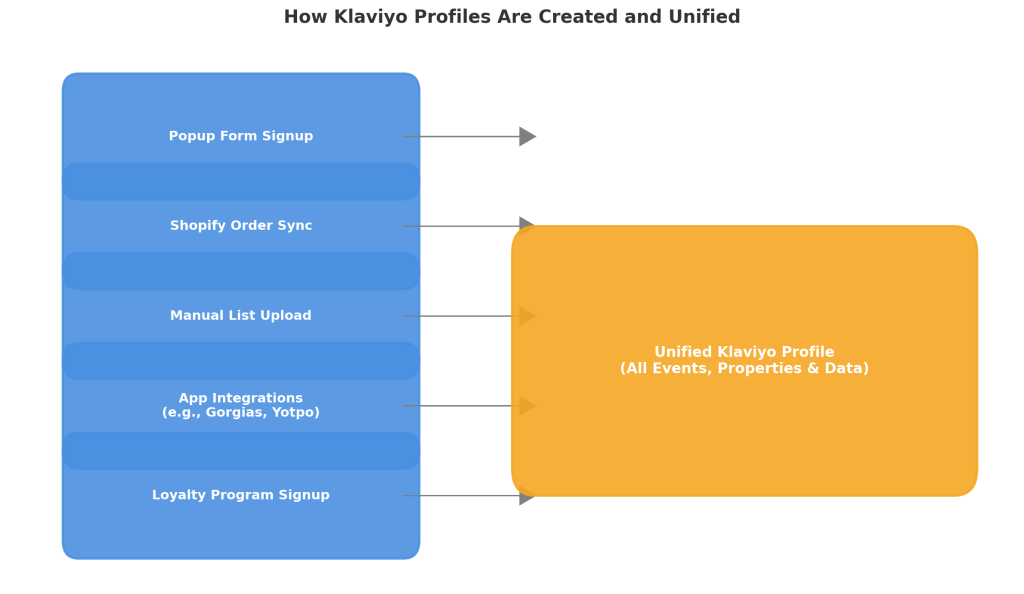
    Profiles can enter your Klaviyo account from multiple sources, including:

    1. Signup forms: When someone joins through a popup, embedded, or landing page form.
    2. Shopify integration: When a customer places an order, Shopify syncs and creates their profile in Klaviyo.
    3. List uploads: When you manually import a list of subscribers or leads.
    4. App integrations: Tools like Gorgias (customer service), Recharge (subscriptions), or Yotpo (reviews) can create new profiles if they don’t already exist in Klaviyo.
    5. Loyalty programs: When someone signs up for your rewards program, Klaviyo generates a new profile if it’s their first time in the system.

    Once a profile is created, every new activity, event, or property associated with that person gets logged and updated.

    Diagram showing how Klaviyo profiles are unified. Input sources like popup signups and app integrations merge into a unified profile with all data.

    What Data Lives Inside a Klaviyo Profile?

    A Klaviyo profile isn’t just a contact card. It’s a 360° view of a person’s relationship with your brand.

    Here’s what you’ll find:

    1. Event History (Metrics)

    Every action a subscriber takes—called a metric or event—is logged. For example:

    • viewed product
    • submitted form
    • subscribed to email
    • placed an order
    • opened or clicked an email

    Each event carries its own properties. For instance, an “Ordered Product” event will show what was purchased, the SKU, price, and order total.

    2. Subscription & Engagement Status

    You’ll see:

    • Whether they’re subscribed to email and/or SMS and/or push notifications.
    • When and how they subscribed (form, integration, upload).
    • Campaigns and flows they’ve received.
    • Opens, clicks, bounces, and spam complaints.

    3. Custom Properties

    This is where Klaviyo shines. Custom properties in Klaviyo are user-defined data points that you can attach to a contact’s profile. Unlike standard fields such as name or email, custom properties let you store information that’s unique to your brand or your customers—giving you richer insights and enabling more personalized marketing.

    These properties can capture anything from demographics and preferences to survey responses and even third-party data pulled in through integrations. We can track their entire customer journey. By going beyond basic contact details, they become the foundation for advanced segmentation, personalization, and automation.

    Examples of Custom Properties

    • Demographic Information: Gender, birthday, age, or location.
    • Customer Preferences: Choices around email frequency, product categories, content type, or communication channels.
    • Behavioral Data: Interests like favorite product types, style preferences (e.g., “casual,” “formal,” “minimalist”), loyalty points or tier, or purchase behavior (prospect vs. repeat purchaser).
    • Survey Responses: Answers collected from quizzes or forms to better understand needs and opinions.
    • Third-Party Data: Imported details such as product ratings, reviews, or even pet information like breed or microchip ID.
    • Source Information: Where a customer came from (e.g., a specific signup form, quiz, lead magnet or ad campaign), often tracked using the $source property.
    • Shopify tags imported through integration.

    How Custom Properties Are Used

    1. Segmentation
      • Group customers by shared attributes for highly targeted campaigns (e.g., sending a skincare line promo to customers who selected “oily skin” in a quiz). Use profile data to build hyper-targeted segments (e.g., “prospects who signed up via quiz but haven’t purchased”).
    2. Personalization
      • Dynamically tailor subject lines, product recommendations, and offers to individual preferences (e.g., “Happy Birthday, Sarah—here’s 20% off your favorite category: Shoes!”). Add splits and conditional logic to flows (e.g., show different messaging to first-time buyers vs. repeat customers).
    3. Automation
      • Trigger flows or campaigns based on property values (e.g., send VIP rewards to loyalty members, birthday offers on the exact date, or replenishment reminders based on quiz answers).

    4. Demographic & Location Data

    Profiles also capture IP-based data and checkout information like:

    • City, state, country.
    • Preferred language.
    • Shipping address from orders.

    This is especially powerful for regional campaigns or localized product launches.

    In short: Klaviyo custom properties transform generic profiles into deep customer insights, giving brands the tools to send the right message, to the right person, at the right time.


    Final Thought

    Klaviyo profiles are the central nervous system of your email marketing. They pull together all your customer data into a single, unified record that grows richer with every interaction.

    When you leverage profiles effectively, you can:

    • Understand your audience deeply.
    • Segment with surgical precision.
    • Deliver personalized, relevant, and timely messages.
    • Drive higher engagement, deliverability, and ultimately—sales.

    If you’re serious about scaling your brand with Klaviyo, start by mastering profiles. Everything else builds on this foundation.

  • Zero-Party Data: The Privacy-First Fuel for Personalization, Trust, and Revenue

    Zero-Party Data: The Privacy-First Fuel for Personalization, Trust, and Revenue

    Zero-party data (ZPD) is information customers intentionally and proactively share with you—preferences, needs, intentions, and context. Because it’s volunteered with consent (not inferred or tracked), it’s the most privacy-friendly and trustworthy data you can use to personalize experiences, deepen relationships, and lift conversions. Collect it through value-rich moments (quizzes, multi-step pop-ups, preference centers, post-purchase surveys, chat/SMS, loyalty), store it cleanly, and activate it across your lifecycle flows and campaigns.

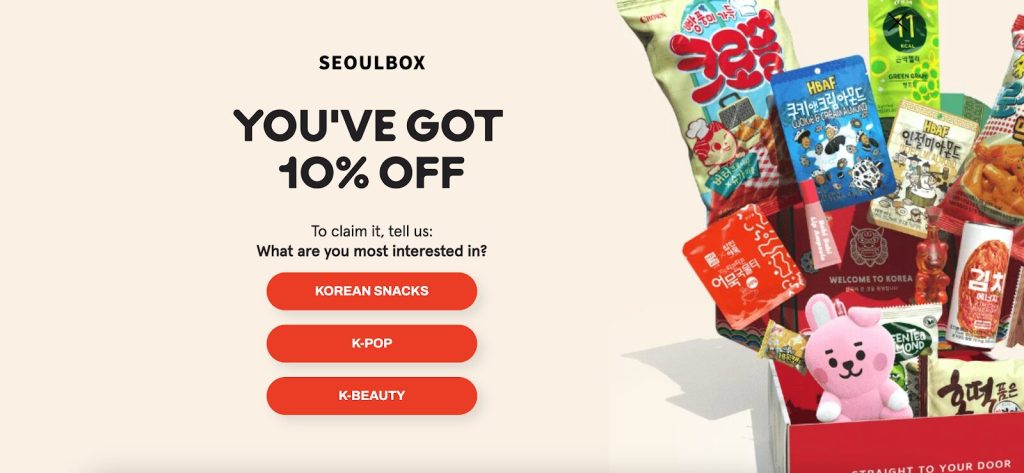
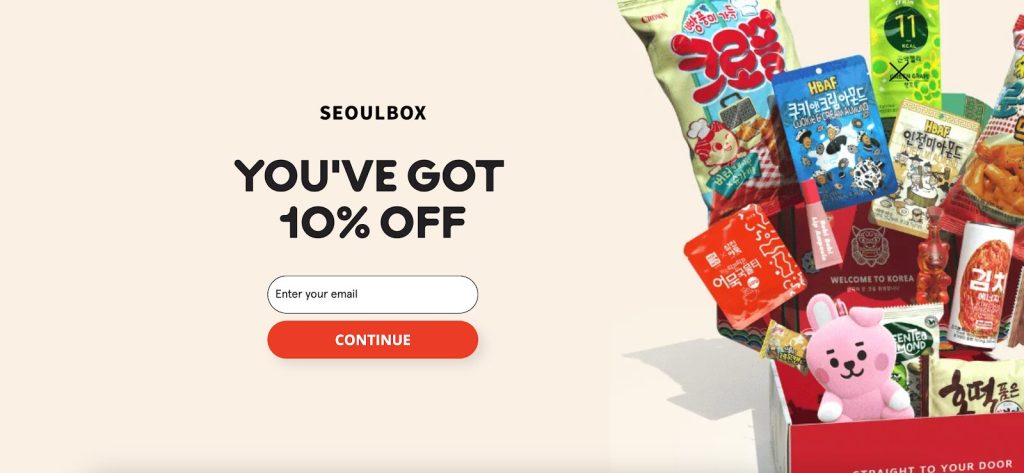
    In this form, Seoulbox seamlessly blends a micro-commitment with zero-party data collection. This allows the brand to segment their audience based on preferences and send more personalized offers. 

    SeoulBox promotion offering 10% off. Left text asks preference: Korean snacks, K-pop, or K-beauty. Right features a box filled with Korean snacks, colorful wrappers, and a pink bunny toy.
    SeoulBox promotion offering 10% off. Korean snacks, K-pop, or K-beauty. Right features a box filled with Korean snacks, colorful wrappers, and a pink bunny toy.

    Zero-party data is your 2025 edge. When visitors tell you who they are and what they want—needs, use-case, budget, preferences—you have a better understanding of your audience and what they care about.

    Capturing those signals at signup enables you to tailor your welcome series from day one: segment the audience, adjust subject lines and offers, swap product recs, and set the right cadence. The result is sharper relevance, higher engagement and deliverability, and faster first-purchase conversions.

    What is Zero-Party Data?

    Zero-party data is data a customer deliberately gives you in exchange for a clear benefit. These include:

    • Directly provided personal information: Customers may share their first name, birthday, preferred sizes, location or favorite colors to receive personalized recommendations. 
    • Purchase intentions & timing: gift vs. self, occasion/date, replenishment cadence, when they want to buy.
    • Communication preferences: Users specifying how they want to be contacted (e.g., email, SMS) and how often. 
    • Preferences: sizes, colors, flavors, styles, skin/hair type, dietary needs, materials, price ceiling.
    • Interests and hobbies: Customers voluntarily providing details about their interests and activities for tailored experiences. 
    • Account settings: Information set by a user within their profile, such as preferred language or content types. 
    • Constraints: budget band, allergies, shipping urgency, room size (for home goods), pet breed/age.
    • Feedback and ratings: Customer reviews or ratings for products and services, which provide direct feedback on their experiences. 
    • Wish lists: Items that customers save to a wish list or “favorites” list, indicating their preferences and potential purchases

    How it differs from other data

    • First-party data: Observed by you (site events, purchases, clicks).
    • Second-party data: Someone else’s first-party data you obtain directly (partnerships).
    • Third-party data: Aggregated/inferred from outside your ecosystem (cookies, brokers).

    ZPD is declared (not inferred), consented, and actionable—perfect for ethical personalization.

    Why Zero-Party Data Is More Privacy-Protected (and Trustworthy)

    1. Explicit consent: Customers choose what to share and why.
    2. Transparent value exchange: You clearly state what they get back (better recommendations, early access, tailored content).
    3. No cross-site tracking: No shadowy cookies or device graphs; trust increases, “creepy factor” drops.
    4. User control: Easy to edit preferences or withdraw consent (via preference centers).
    5. Higher accuracy: Self-reported > guesswork. Less waste, better relevance.

    Key characteristics: Voluntary, contextual, specific, revocable, identity-resolved, and immediately useful.

    Why It Matters: Engagement, Deliverability, Conversions

    • Relevance → opens & clicks: People engage with what reflects their stated needs.
    • Better deliverability: Higher interaction improves sender reputation and inbox placement.
    • Lower CAC wastage: Send fewer irrelevant messages; convert traffic you already paid for.
    • Faster path to value: Get to the right product/story faster; reduce bounce and hesitation.
    • Deeper loyalty: Transparent, helpful personalization builds durable trust.

    The Best (Proven) Ways to Collect Zero-Party Data

    Zero-party data can be collected in many ways, but the key is making it feel natural and valuable for the user. If the process feels forced or overwhelming, people won’t share their information. Instead, use simple, engaging experiences that clearly show the benefit of sharing data. Treat it as a fair exchange—personal information for personalized value—and you’ll succeed in collecting zero-party data.

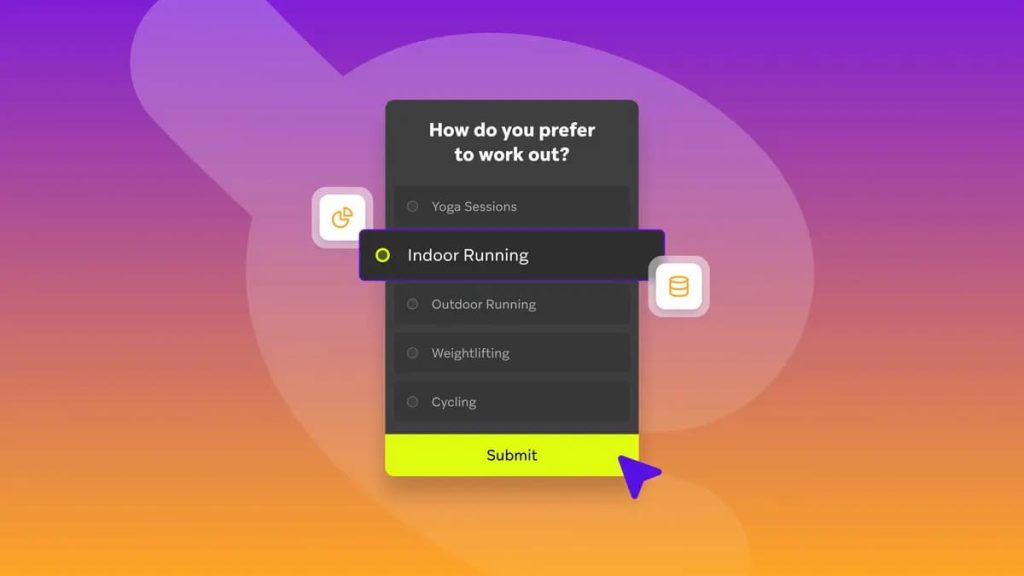
    A colorful gradient background with a workout preference poll. Options include Yoga, Indoor/Outdoor Running, Weightlifting, and Cycling. "Indoor Running" is selected, and a purple pointer is near the yellow "Submit" button, creating an interactive feel.

    Low-Friction Zero-Party Data Collection

    Best for early funnel engagement when you want to keep signups smooth and fast.

    • Interactive Signup Forms: Add simple optional fields directly on your signup forms asking about their preferences, so you can personalize their experience right off the bat.
    • Polls & Q&A Sessions: Use quick polls or live Q&As on social media to gather lightweight insights.
    • Chatbots & Live Chat: Ask a few contextual questions in real time to personalize recommendations.
    • User Profiles (Lite): Encourage customers to add a few basics like name, birthday, or style preference without requiring too much upfront effort.

    High-Value Exchange Zero-Party Data Collection

    Best for when customers are already engaged and willing to trade more details for value.

    • Surveys: Use style finders, product match tools, or satisfaction surveys that deliver tailored results. Avoid generic surveys—make them relevant to the user’s journey. For example, if they just made a purchase, ask specifically about that experience.
    • Quizzes: Offer high-value tools like skincare match quizzes or ROI calculators in exchange for preferences. People love interactive quizzes that reveal something about themselves—then, by asking for an email to deliver personalized results, you seamlessly collect zero-party data.
    • Interactive Tools: Interactive tools—like mortgage calculators or skin type assessments—provide real value while capturing valuable user preferences at the same time.
    • Preference Centers: Let customers update detailed communication, content, and interest settings on your site or app.
    • Loyalty Programs: Offer points, discounts, or VIP perks in return for detailed preference sharing and purchase history.
    • Giveaways & Contests: Require personal details to enter, balancing fun engagement with useful data collection.
    • Gated Content: Trade access to e-books, guides, or webinars for richer customer information.
    • Social media: Use interactive polls or Q&A sessions to engage your audience while collecting zero-party data directly from their responses.
    • Transactional data: After a purchase, capture info like ‘would you like to be part of our loyalty program?

    How to Use Zero Party Data

    Zero-party data is a powerful way to deliver personalized customer experiences because it comes directly from users. Here are some effective ways to put it to work:

    • Craft tailor-made promotions and deals – Offer discounts or special offers that align with individual customer preferences.
    • Create campaign content that hits the mark – Use insights to shape content that resonates with your audience’s interests.
    • Personalize the customer journey – Deliver relevant product recommendations, targeted emails, and tailored website experiences.
    • Build stronger relationships – Use personalization to show customers you understand their needs, fostering trust and loyalty.

    Together, these methods give brands a mix of lightweight, low-friction insights and deep, high-value data that fuels personalization without damaging the customer experience.

  • High-Impact Content Every Email List Needs: Build Trust, Educate & Drive Sales

    High-Impact Content Every Email List Needs: Build Trust, Educate & Drive Sales

    Why High-Quality Content Matters

    No one wants to open their inbox to find desperate, repetitive discount offers. It feels needy—and customers can sense it. When your emails scream “pick me!” through endless coupons and flash sales, you position your brand as one that lacks confidence and value. Worse, you teach customers to only buy from you when there’s a discount.

    Instead, the most successful brands focus on sending valuable, high-quality content that educates, builds trust, and positions their products as the natural solution—all without relying on slashing prices.

    This approach transforms your emails from an annoying sales pitch into a trusted resource. It attracts more loyal customers who are happy to pay full price because they’re confident in what they’re buying.


    Education and Positioning: Your key to sales without discounts

    Today’s consumer does their research. They read reviews, compare competitors, and want to understand exactly what they’re buying. That’s why the best type of content to send subscribers does two critical things:

    1. Educate your customer on a problem, process, or solution.
    2. Position your product as the best way to solve that problem.

    When you achieve both, you remove friction from their decision-making process. You become a guide who helps them make an informed purchase they feel great about. This earns you trust—trust that translates directly into conversions and higher lifetime value.


    The power of educational frameworks

    By strategically educating customers on problems and processes first, you prime them to see the value in your solution. This is the “solution education” framework. It works by creating a natural progression:

    You make them aware of the problem (or deepen their understanding of it).
    You walk them through the process.
    You show how your product fits seamlessly as the answer.

    Done right, this feels helpful and empowering to the subscriber—not pushy.

    Examples of educational content frameworks:

    Problem Education

    • Why many fail to achieve XYZ
    • What is XYZ? (explaining a topic or pain point)
    • Why most XYZ solutions fail

    Process Education

    • How to achieve XYZ
    • What people say about XYZ product
    • How and why XYZ product works
    • How to use XYZ product

    Each of these makes your audience smarter, builds their confidence, and strengthens their connection to your brand.


    Using microtopics to make your content stick

    Trying to cover too many points in one email is a common mistake. People skim emails, so it’s crucial you keep your content focused on one topic, one takeaway, one message.

    This is where microtopics come in. Microtopics are small, easily digestible subtopics pulled from your larger educational themes. Each email you send should tackle just one microtopic, making it simple for customers to remember and act on.

    Always ask yourself:
    “What is the one thing I want my subscriber to know after reading this email?”


    How to create microtopics

    You can generate hundreds (even thousands) of microtopics within your niche. Start by breaking down your biggest topics—your industry, your customer problems, your product benefits—and then isolate small, focused ideas.

    For each microtopic, create a standalone email. This lets you build a robust library of content that educates, positions, and keeps your brand top of mind.


    29 proven microtopic ideas for your emails

    Here’s a comprehensive list of microtopic-driven content you can use to educate your subscribers, build trust, and ultimately drive sales—without looking desperate.


    1. Highlight one benefit

    Pick a single, compelling benefit of your product and explore it. For example: “How our pillow helps you sleep deeper.”

    2. Highlight one feature

    Spotlight one unique feature that sets your product apart. Break down individual ingredients or materials—each is its own microtopic.

    3. Answer a FAQ

    Choose a common customer question and answer it thoroughly.

    4. What’s inside

    Unpack what comes in an order. If it’s food, supplements, or a bundle, list everything clearly.

    5. How it’s made

    Walk through your production process. This builds story, transparency, and trust.

    6. How to use it

    Provide a simple, step-by-step usage guide. Remove all uncertainty.

    7. Back in stock

    Create excitement and urgency around popular products that have returned.

    8. Trending products

    Feature your best-sellers and explain why customers love them.

    9. Review or testimonial spotlight

    Feature powerful reviews that handle objections or highlight transformation.

    10. Us vs Them

    Create a side-by-side comparison showing how you outperform competitors.

    11. Myths vs Facts

    Bust common misconceptions in your industry.

    12. Blog promotion

    Tease an educational blog post and drive clicks to your site.

    13. Research highlight

    Feature a study or stat that supports why your product works.

    14. Holiday angle

    Tie your content to unique or quirky holidays relevant to your product.

    15. Progress update

    Share company milestones or industry developments.

    16. Customer transformation

    Tell a compelling story of how your product changed someone’s life.

    17. Before vs After

    Visually show the difference your product makes.

    18. Puzzle or riddle

    Engage subscribers with fun, themed brain teasers.

    19. Note from the founder

    Add a personal touch with updates or thoughts from the founder or CEO, sharing insights, company news, or a personal touchpoint with subscribers.

    20. Gift guide

    Curate a list of recommended products for specific occasions, helping subscribers find the perfect gift.

    21. Treat yourself

    Encourage self-care or indulgence with products designed to pamper or treat the subscriber.

    22. Media highlights

    Share media mentions, highlighting press coverage, articles and publications that build authority.

    23. Behind the scenes

    Show your team, your culture, or how you create your products.

    24. Tips & tricks

    Offer practical advice, hacks or strategies that helps your audience solve problems or get more from your product.

    25. UGC features

    Spotlight customer photos, stories, or videos to build community.

    26. Sneak peeks

    Give exclusive early looks at upcoming products, content or features, building anticipation and excitement among your subscribers.

    27. Flashback Friday

    Share a nostalgic milestone or a throwback.

    28. Staff picks

    Highlight favourite products, books or tools selected by team members, offering personalized recommendations to subscribers.

    29. Brand mission & values

    Communicate the core values and mission of your brand, reinforcing your commitment to certain principles, and building trust with your audience.


    The Big Takeaway

    When you shift from pushing desperate discounts to sending educational, high-value content, your subscribers stop seeing you as a salesman—and start seeing you as a trusted advisor. This not only builds a stronger brand, it leads to more confident, higher-value purchases made without hesitation or heavy discounts.

    Remember:

    • One email.
    • One topic.
    • One takeaway.

    Educate, position, and build trust. That’s how you win.

  • Quality Content: The Fuel Behind Profitable Email Marketing in 2025

    Quality Content: The Fuel Behind Profitable Email Marketing in 2025

    In 2025, email marketing remains the single most profitable channel for e-commerce brands—but only if you feed it with the right fuel: quality content.

    Your email list is your most valuable owned asset. It’s the one channel you truly control—unlike social media platforms, which can change algorithms overnight. But a list alone won’t generate sales. Your content determines whether people open, read, click, buy… or unsubscribe forever.

    If you want to grow your list, improve open rates, boost sender reputation, and avoid the dreaded unsubscribe spike, you must understand this: content is everything.

    Every Channel Should Work for Your Email Marketing

    Every single digital touchpoint—social media, ads, SEO, influencer partnerships—should have one ultimate goal: bring people into your email ecosystem.

    • Social media posts should spark curiosity and drive signups. That TikTok, Instagram Reel, or YouTube Short? It’s bait. The hook is the email signup that follows.
    • Paid ads should capture emails first, sales second. A click without a captured address is just rented attention.
    • SEO content should lead to valuable downloadable resources that collect email addresses.
    • Influencer collaborations should funnel followers into your list with exclusive offers they can only get via email.

    Why? Because once someone joins your list, you can market to them for free, repeatedly—without paying for every impression or click.

    Why Content Is the Lifeblood of Your Email List

    It’s your content that convinces someone to join your list. It’s your content that keeps them opening your emails week after week. And it’s your content that turns them into repeat buyers.

    Think about it:

    • A killer welcome email builds trust from day one.
    • A clever subject line gets you opened in a sea of unread messages.
    • A value-packed newsletter makes your audience look forward to hearing from you.
    • A high-converting sales email turns subscribers into paying customers.

    Without great content, your email list is just a database of ignored inboxes.

    The 2025 Consumer Has Changed

    The modern consumer’s attention span has been rewired by TikTok, Instagram Reels, Snapchat, and YouTube Shorts. Bite-sized content delivering instant dopamine has become the norm.

    That means your emails must adapt:

    • In 2020: You had 5–10 seconds to get your message across.
    • In 2025: You maybe have 3 seconds.

    And remember, email is no longer a sit-down activity. People check email in bursts—between tasks, waiting in line, walking to their car, or yes… on their way to the bathroom.

    They’re scanning. They’re multitasking. They’re distracted. If your content doesn’t hook them instantly, they’ll swipe past without a second thought.


    Why Discounts Alone Won’t Save You

    Some brands try to keep subscribers engaged by sending constant discounts. That’s a fast track to eroding your margins and training customers to only buy during sales.

    If the only reason someone stays on your list is for coupons, you haven’t built a relationship—you’ve built a dependency. And the moment you stop discounting, sales vanish.

    The brands that win in email marketing create value through content that educates, entertains, and inspires—so that customers stay for the experience, not just the savings.


    How to Make Emails People Crave

    To make your subscribers treat your emails like they treat their favorite social feed, your content needs to deliver that same “instant hit” feeling.

    That means:

    • Subject lines that spark curiosity — think scroll-stopping, not corporate.
    • Bite-sized, easy-to-skim layouts — use short sentences, bold subheads, and striking visuals.
    • Story-driven content — hook them with a narrative, even if it’s only three lines long.
    • Interactive or visual elements — GIFs, quick polls, carousel images to make the email feel dynamic.
    • Real value in every send — a tip, a story, a sneak peek, or exclusive content they can’t find anywhere else.

    When people look forward to your emails, open rates rise, sender reputation improves, and unsubscribes drop.

    Turn Subscribers into Fans with Emotional Emails

    Generally, the longer someone stays on your email list, the less engaged they become. Over time, people will naturally lose interest in your brand and your emails. So, you might have over 100,000 subscribers, but only 5,000 of them may be active.

    However, you can completely flip that script with the right content strategy. One of the most effective ways to keep your subscribers engaged is by sending a variety of email types—and making sure one of those is designed purely to connect on an emotional level.

    These aren’t sales emails and they’re not even about your brand. Instead, they’re crafted to spark feelings, trigger curiosity, or inspire joy—delivering that same dopamine hit your audience gets from their favorite social media feeds. When you create emails people feel rather than just read, they start looking forward to opening them. That’s how you turn passive subscribers into loyal, engaged fans.


    Why This Matters to Your Bottom Line

    Optimized content isn’t just nice to have—it’s the difference between a profitable email list and an expensive, unresponsive one. More Engaged Subscribers = More Money You Make!

    Great content leads to:

    • Higher open rates (more eyes on your offers)
    • Better click rates (more traffic to your store)
    • Fewer unsubscribes (your list grows instead of shrinking)
    • Improved sender reputation (more inbox placement, less spam folder)

    This compounds over time. The bigger and more engaged your list, the more revenue you generate—without increasing ad spend.


    The Takeaway:

    In 2025, email marketing is still king—but only if your content wears the crown. Every marketing channel should work to grow your list, and every email should be a piece of content people want to open.

  • Why Writing Effective Email Copy in 2025 is Harder Than Ever (And How to Actually Win)

    Why Writing Effective Email Copy in 2025 is Harder Than Ever (And How to Actually Win)

    Welcome to 2025 — the year email marketers have to battle shrinking attention spans, relentless dopamine-chasing habits, and a marketplace so crowded that brands vanish without a trace if they don’t stand out.

    If writing effective email copy was tough before, it’s become an Olympic-level sport today. If you aren’t able to stay up-to-date with what’s changing, your conversions will stay low and you will not be able to maintain profitability.

    Let’s dive into why writing email copy in 2025 is so brutally challenging, and more importantly, how you can master it to engage, inform, and convert your audience before your email gets tossed aside in 3 seconds flat.

    The brutal reality of email marketing in 2025

    People still check their emails multiple times a day.
    But here’s the truth: they don’t read. They skim.

    They scroll fast. They glance at subject lines.
    And they delete even faster.

    If your email doesn’t look useful, personal, or relevant immediately, it’s gone.


    TikTok and Instagram have rewired our brains.
    Dopamine on tap. Instant gratification.
    Attention spans are shrinking by the year.

    • In 2015, you had 10 seconds.
    • In 2020, you had 5.
    • In 2025? You’ll get 3 seconds. That’s it.

    Think about when people actually open emails.

    • In between meetings.
    • Waiting in line for coffee.
    • Late at night in bed.
    • While multitasking.

    Nobody is sitting down to “savor” your newsletter.

    Emails are scanned, not studied.
    Your audience is looking for one thing:
    A reason to click—or a reason to delete.

    Why traditional copywriting has failed

    Too many brands still rely on bloated, “look at us” emails that brag about how great their products are in huge text blocks. The modern customer? They see that and immediately bounce.

    Why? Because:
    ✅ It’s too long.
    ✅ It’s boring.
    ✅ It doesn’t give them that quick dopamine hit they’re used to from their favorite apps.

    As David Ogilvy put it, you can’t “bore” people into buying. And yet, countless emails try to do exactly that.

    How to write email copy that actually converts in 2025

    So, how do you stand out in this lightning-fast, dopamine-chasing environment? You must do what social media has mastered:

    ✅ Be instantly engaging
    ✅ Offer rapid, visual rewards
    ✅ Deliver bite-sized value that feels good to consume

    Here’s how to do it.

    1. Make your brand voice unforgettable

    A bland, generic voice is a death sentence in 2025’s inbox. Your copy must carry a unique, branded personality that can’t be mistaken for anyone else.

    • Use playful puns, clever metaphors, or an edgy attitude.
    • Don’t be afraid to show humor or quirks.
    • Write like a human, not a corporation.

    This is what cuts through the noise and allows you to stand out in an ever-saturated ecommerce market. People don’t just buy products — they buy personalities they like.

    2. Be painfully concise. Then go shorter.

      Long-winded copy is out. Even useful, smart content will get skipped if it’s too long.

      • Focus on one point, one takeaway per email. A single clear takeaway is far more likely to stick with your customer than trying to deliver three or more at once.
      • Focus on delivering one main point in each email. You can include smaller supporting sub-points, but the goal is for your audience to walk away remembering that single, clear takeaway.
      • Avoid unnecessary information.
      • Use short, punchy sentences.
      • Break up text with plenty of line breaks so people can skim.
      • Keep your emails ideally within 1-2 scrolls.

      If you’re not sure if your copy is short enough, cut it in half again. Your goal isn’t to write everything — it’s to write the essence.

      3. Optimise for the skim, not the read

        People rarely read emails. They skim. If your email isn’t designed to be scanned in 3 seconds, it’s not going to get read.

        • Use bold headers to highlight your main points, and provide supporting details beneath each one so readers can dive deeper if they choose.
        • Add bullet points or numbered lists.
        • Avoid using blocks of text.
        • Include visuals like checklists, icons, and diagrams that let people grasp your message at a glance.
        • Keep paragraphs to 1-2 lines.

        This is how you turn casual skimmers into engaged buyers.

        4. Deliver instant dopamine

          Remember: your real competition isn’t another email. It’s TikTok, Reels, Shorts — all engineered for instant pleasure. People remember how you make them feel, so your emails should aim to spark a positive emotional response.

          Your copy needs to trigger micro-dopamine hits by:

          ✅ Using humor, wit, puzzles and clever one-liners.
          ✅ Including engaging visuals like GIFs, memes, or cheeky illustrations.
          ✅ Providing small “aha!” moments — surprising facts, playful language, mini-puzzles, or hyper-relatable jokes.

          Every element should make your reader feel something. That feeling builds a positive association with your brand that pays off in future opens and sales because they know it will leave them feeling good.

          5. Provide real, skimmable value

            The modern customer has seen it all. They know if your email is just fluff to fill space. If you don’t have some sort of clear value proposition, you’ll fail to capture and retain interest. Give them something tangible:

            ✅ A short checklist they can screenshot
            ✅ A quick comparison chart to simplify decision-making
            ✅ A feature diagram that visually sells your product
            ✅ A numbered “3-step” plan to solve a problem
            ✅ An exclusive offer or engaging stories.
            ✅ A progress timeline so they know what happens next

            This is dopamine + education in one punch. They learn quickly, feel smarter, and start trusting your brand.

            6. Make your headline the star of the show

              Your headline is the gatekeeper. Everything else is wasted if it doesn’t pull people in.

              • Be crystal clear on your promise.
              • Use powerful, curiosity-driven words.
              • Make sure the body copy only exists to support the headline.

              If your headline is about how your pillow gives the deepest sleep ever, every sub-point and graphic needs to hammer that home.

              7. Provide valuable information

                People love to learn and feel confident in their purchasing decisions.

                • Share real, credible facts that genuinely educate your audience.
                • Teach them something new every time they open your email.
                  Offer little-known insights that make your content both memorable and worth reading.
                • Aim to craft powerful, punchy emails that spark emotion while delivering a wealth of information in a concise, impactful format.

                8. Use modern formatting tools that delight

                  In 2025, static blocks of text look like ancient relics. Mix things up with:

                  ✅ Checklists & infographics – Show benefits creatively.
                  ✅ Icons & feature diagrams – Let the brain process features at a glance.
                  ✅ Timelines – Map out results over days or weeks.
                  ✅ Comparison charts – Let them see why you win vs competitors.
                  ✅ Flow charts & graphs – Make complex ideas instantly clear.
                  ✅ Playful touches – Tiny quizzes, “choose your adventure” flows, or cheeky emojis.

                  9. Avoid cramming in multiple points—focus on one clear message

                    Customers can easily feel overwhelmed by too much information.

                    ✅ Sharing multiple takeaways in one message reduces the chance of any being remembered.
                    ✅ Focusing on a single takeaway makes it more likely to stick in the customer’s mind.
                    ✅ A clear, focused message increases retention and impact.
                    ✅ One email, one point, one goal — improves clarity and results.

                    The ultimate rule: One email, one takeaway

                    If you try to cram in five points, they’ll remember none. But one powerful point? That sticks.

                    So pick one:

                    🔥 One benefit
                    💡 One myth busted
                    🎯 One customer transformation
                    📝 One juicy stat

                    Drive it home. That’s what leads to clicks and sales.

                    10. Aim to sell the click

                      The primary goal of most marketing emails isn’t to sell the product directly — it’s to sell the click. Your job is to craft copy that gets subscribers from the inbox to your website, because if they don’t click through, they can’t browse, shop, or buy.

                      Instead of overloading the email with too much detail, focus on sparking curiosity, highlighting value, and creating a clear next step. The product page will do the heavy lifting — your email’s role is to get them there.

                      This approach is especially effective during promotions or product launches, when your audience is already familiar with your brand. In these moments, education has often been done by previous campaigns — now it’s all about removing friction and driving clicks. The more effectively you sell the click, the more traffic (and conversions) you’ll generate.

                      Bottom line: To win in 2025, you need short, punchy, dopamine-rich copy that’s too engaging to ignore.

                      The inbox is no longer a leisurely reading spot — it’s a battleground for milliseconds of attention. If your copy isn’t instantly valuable, delightfully entertaining, or visually irresistible, you’ll lose your customer to TikTok or Instagram in a heartbeat.

                      Want your emails to actually work?

                      Be clear.
                      Be quick.
                      Be fun.
                      Be memorable.

                      That’s how you turn the toughest email landscape in history into your brand’s biggest asset.

                    1. Content for Email Growth: The 2026 Playbook for Brands

                      Content for Email Growth: The 2026 Playbook for Brands

                      In 2025, email marketing is still the most profitable channel for brands—but the game has changed. Consumer attention spans have shrunk, inboxes are more crowded than ever, and competition for the click is fierce. Simply sending more emails isn’t the answer. The brands that win the inbox are the ones that send content people actually want to open with content they want to engage with.

                      Your email content is more than just words on a screen—it’s your ticket to growing your subscriber list, boosting open and click rates, improving sender reputation, and keeping unsubscribes to a minimum. Every channel you use—social media, paid ads, SEO—should serve one purpose: fueling your email marketing with a steady stream of engaged, eager subscribers.This playbook will show you exactly how to do it—step by step.

                      From capturing attention in just three seconds to creating emails people crave, here’s how to turn your content into your most powerful email growth engine in 2025.


                      Step 1 — Use Every Channel to Grow Your Email List

                      Your email list is your most valuable asset—so make sure every piece of marketing you do points back to it.

                      Tactics:

                      Social Media → Email: End every TikTok, Instagram Reel, or YouTube Short with a call to action to join your email list for exclusive tips, early access, or VIP deals.
                      Paid Ads → Email: Run lead-generation ads offering something irresistible (e.g., “Free Guide,” “Exclusive Offer,” “Early-Bird Access”) in exchange for an email address.
                      SEO Content → Email: Add embedded sign-up forms in blog posts with content upgrades like checklists, templates, or mini-courses.
                      Influencer Collabs → Email: Have influencers drive traffic directly to your email sign-up with unique, limited-time bonuses for their followers.

                      Key Principle:
                      Every channel is a recruitment tool for your email list. Don’t waste the attention.

                      Step 2 — Win the 3-Second Inbox Battle

                      In 2025, you have an average of 3 seconds to grab attention in the inbox.

                      Tactics:

                      Subject Lines: Make them curiosity-driven or benefit-driven. Use emotional triggers (e.g., “The mistake costing you sales” or “Open for your free design toolkit”).
                      Preheader Text: Treat it like a second headline—don’t waste it with “View this email in your browser.”
                      Personalization: Use the subscriber’s name, location, or past behavior where relevant.

                      Pro Tip:


                      A/B test subject lines every single send. Even small differences can swing open rates dramatically.

                      Step 3 — Make Emails Skimmable

                      Most people don’t read emails word-for-word—they scan.

                      Tactics:

                      • Use short paragraphs (1–2 sentences max).
                      • Break content into clear sections with bold headings.
                      • Use icons for key info.
                      • Include visuals or GIFs to reset attention.

                      Rule:
                      Your subscriber should be able to understand your core message in under 5 seconds without reading everything.

                      Step 4 — Deliver Value in Every Email

                      Value keeps people subscribed. Value earns you clicks.

                      Value Types:

                      Educational: Tips, tutorials, how-to guides relevant to your product.
                      Entertaining: Stories, behind-the-scenes, customer spotlights.
                      Exclusive: Early access, VIP offers, private launches.

                      Formula:
                      Value First → Soft Sell Second.
                      Earn the right to make an offer by delivering something useful up front.
                      Step 5 — Avoid the Discount Dependency Trap

                      Discounts have their place—but overusing them trains customers to wait for sales.

                      Tactics:

                      • Offer non-discount incentives like free resources, exclusive content, or members-only perks.
                      • When using discounts, tie them to special events (e.g., anniversaries, new product launches) to keep them meaningful.

                      Step 6 — Protect Your Sender Reputation

                      Even great content can fail if your emails don’t land in the inbox.

                      Tactics:

                      • Remove inactive subscribers regularly.
                      • Avoid spammy words in subject lines (“FREE!!!” “Act now!!!”).
                      • Keep engagement high with targeted segmentation—send relevant content to the right people.

                      Step 7 — Reduce Unsubscribes with the “Email Experience” Mindset

                      People unsubscribe when they don’t see value or feel bombarded.

                      Tactics:

                      • Set clear expectations at signup (“You’ll get 2 emails a week with…”)
                      • Make it easy to update preferences instead of fully unsubscribing.
                      • Surprise subscribers with unexpected value—like a bonus guide, thank-you note, or insider tip.

                      Step 8 — Frameworks for High-Performing Email Content

                      Here are 3 ready-to-use structures you can plug into your own campaigns:

                      1. The Story-Offer-Action (SOA) Email Story: Start with a quick, relatable narrative.
                        Offer: Link the story to your product/service.
                        Action: Clear, compelling CTA.
                      2. The Quick Tip Email Tip: One fast, actionable piece of advice.
                        Example: Show it in action.
                        Link: Drive to related products or resources.
                      3. The Curated List Email Intro: “Here’s what we’re loving this week…”
                        List: 3–5 quick recommendations.
                        CTA: “Shop our favorites” or “Learn more.”

                      Step 9 — Track, Learn, Optimize

                      Email marketing is not “set it and forget it.”

                      Track:

                      • Open rate (attention capture)
                      • Click (content effectiveness)
                      • Unsubscribe rate (list health)

                      Optimize:

                      Double down on content themes that get the highest clicks.
                      Retire or rework low-performing templates.

                      Bottom Line:


                      Email marketing isn’t just another channel—it’s your brand’s most reliable revenue driver. But without intentional, value-packed content designed to win attention and keep it, your list will stall, your open rates will drop, and your growth will plateau.

                      The brands that dominate inboxes in 2025 will be the ones who treat content not as filler, but as their most important sales tool.

                    2. The Fundamentals of a Successful Email Campaign Strategy

                      The Fundamentals of a Successful Email Campaign Strategy

                      Email marketing is still one of the highest-ROI channels available to brands—but success isn’t about blasting offers into inboxes. It’s about sending the right message, at the right frequency, with the right mix of value and sales intent.

                      Here’s how to build an email marketing campaign strategy that drives engagement, nurtures trust, and maximizes conversions.

                      1. How Often Should You Send?

                      Frequency is one of the most important levers in your email strategy.

                      • Too little and your audience forgets you exist.
                      • Too much and you risk annoying them into unsubscribing.

                      Why once a week isn’t enough:

                      The average American is exposed to over 70 e-commerce brands per day—younger audiences see almost double. By the end of the week, your subscribers have been exposed to 490+ brands, making it easy for your emails to get lost in the noise.

                      Sending only once a week doesn’t create the familiarity needed for them to habitually open your emails. 5 or more emails per week is too much often leads to higher unsubscribe rates, audience fatigue, and dilutes the impact of your messaging.

                      According to email expert Max Sturtevant, who has generated $100M+ for brands and tested sending frequencies over two years, 2–4 campaigns per week hits the balance between:

                      • High engagement
                      • Strong familiarity
                      • Low unsubscribes
                      • Equal impact per email

                      Pro tip: A/B test your own sending frequency. Monitor open rates, click rates, and unsubscribe rates to see what resonates with your audience.

                      2. What Should You Send?

                      If all you send are discounts, promotions, and “buy now” emails, you’ll create sales resistance. Your brand will appear desperate for sales, and desperation doesn’t sell.

                      Instead, adopt an altruistic content strategy—one that focuses on giving value first.

                      Benefits of this approach:

                      1. Avoids annoying your list with repetitive sales messages.
                      2. Positions you as a sought-after, confident brand that people want to buy from.

                      Content ideas that build trust and loyalty:

                      • Messages from the founder (brand journey, mission, vision)
                      • Tips & tricks relevant to your product or industry
                      • Product & collection spotlights: highlight the best products from your catalog
                      • Industry insights (“What does X mean?” or “Watch out for Y”)
                      • Lifestyle content that is relevant to your niche and helps customers outside of your product scope
                      • Educational content that addresses a common problem and positions your product as the solution

                      3. The Modern Consumer Wants to Do Their Homework

                      Today’s buyers want to research before purchasing. They need to understand:

                      • What your product does
                      • Why it’s better than alternatives
                      • How it solves their problem

                      Your job is to remove friction from that decision-making process. The more you educate and support them through this journey, the more you increase your brand’s perceived value.

                      Every valuable, trust-building email earns you “trust points”—and when it’s time to make the ask, you can cash in those points for sales.

                      4. The Power of Micro-Topics

                      Your subscribers will give your email 3–5 seconds of attention. That’s it. If your email tries to cover too much, nothing sticks.

                      The rule:
                      One email. One topic. One takeaway.

                      By breaking your campaigns into micro-topics (small, focused points about your industry, process, or product), you:

                      • Make the content easier to digest
                      • Increase the chance they’ll remember it
                      • Avoid overwhelming the reader

                      Example:
                      Instead of an email titled “10 Ways to Get the Most From Our Product,” send 10 separate emails, each covering one tip in detail.

                      5. Bringing It All Together

                      A winning email campaign strategy means:

                      • Frequency: 2–4 campaigns per week for familiarity and engagement
                      • Content mix: Value-driven, educational, and brand-story content—sales messages sprinkled in strategically
                      • Focus: One topic per email for maximum retention
                      • Measurement: A/B test frequency and content types, then optimize

                      When done right, your emails stop feeling like spam and start feeling like a welcome presence in your subscribers’ inbox—turning strangers into customers, and customers into loyal advocates.

                      4-Week Email Marketing Calendar (3–4 Sends Per Week)

                      Frequency: 3–4 emails/week
                      Goal: Build familiarity, earn trust points, and position your product as the natural solution while avoiding sales resistance.

                      Week 1

                      DayEmail TypeMain FocusExample Subject Line
                      TuesEducational / Problem AwarenessMicro-topic #1 — “The problem your audience faces”“Why this problem is costing you more than you think”
                      WedValue-Driven ContentTips & tricks relevant to your product use case“3 simple tweaks to get better results instantly”
                      ThurSoft Offer / Social ProofPosition your product as the solution (include testimonial)“How Sarah solved this in just 2 days”

                      Week 2

                      DayEmail TypeMain FocusExample Subject Line
                      TuesFounder StoryBrand mission, origin, values“Why I started [Brand]”
                      WedEducational / Micro-topicA specific industry insight“The one thing 90% of people overlook”
                      ThurOffer (Light Push)Introduce a relevant product with urgency“If you’ve been thinking about this… now’s the time”

                      Week 3

                      DayEmail TypeMain FocusExample Subject Line
                      TuesLifestyle / Everyday ValueContent not directly about the brand but relevant to customer’s life“Your Monday productivity booster”
                      WedEducationalMicro-topic #2 — Step-by-step solution breakdown“The easiest way to fix this without wasting hours”
                      ThuSocial Proof / Case StudyShowcase success story“From struggle to success — real customer story”
                      SatSoft OfferTie content back to product as natural next step“Your next win is waiting for you”

                      Week 4

                      DayEmail TypeMain FocusExample Subject Line
                      Tues“Watch Out For…”Industry warning or common mistake“Avoid this costly mistake”
                      WedEducationalQuick actionable tip (micro-topic #3)“2-minute fix for [problem]”
                      ThurStrong Offer / UrgencyShort-term promo or limited stock“Ends tonight: don’t miss this”

                      Notes for Execution:

                      • Keep each email focused on one takeaway (micro-topic principle).
                      • Include a mix of value-first and conversion-focused sends to avoid sales fatigue.
                      • A/B test subject lines for each campaign to find best open-rate drivers.
                      • Rotate between problem awareness → solution → proof → offer to create a natural buying flow.